What it means
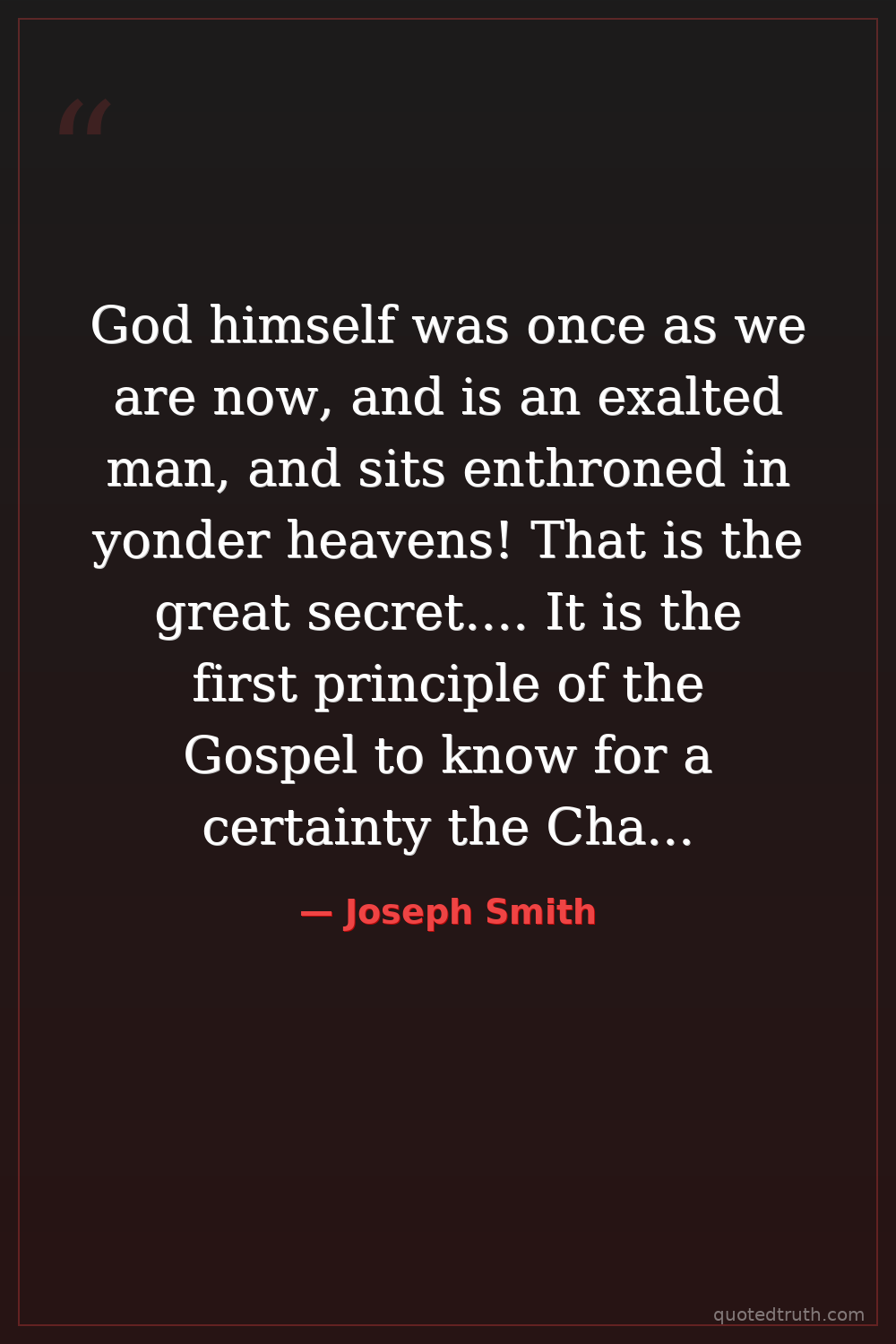
God was not always divine but was once a mortal human who progressed to godhood — and humans can follow the same path. Divinity is not a fixed, exclusive state but an achievable destiny. Eternal life means knowing God's true nature and actively becoming like him. Every person carries the potential for divine transformation, ascending the same path that God himself once walked as a mortal.
Relevance to Joseph Smith
Smith delivered this in April 1844 — the King Follett Discourse, his final major theological statement before his murder in June 1844. It crystallized his radical break from traditional Christianity: God as an evolved, embodied being rather than an eternal abstract spirit. His entire prophetic career pushed toward democratizing the divine — claiming direct revelation, restoring priesthood authority, and now declaring that human ascent to godhood was the very purpose of existence.
The era
America in the 1840s was in religious ferment — the Second Great Awakening had democratized faith, challenging old hierarchies and emphasizing personal salvation. Frontier culture prized self-made transformation. If any man could rise from poverty to president, why not from mortality to godhood? Smith's theology directly challenged Calvinist predestination and the distant sovereign God of established Protestantism, offering instead a relational, achievable divinity that resonated with American egalitarianism.
AI-generated insights based on extensive research and information for context. Factual errors? Email [email protected].