Charles Darwin — "Great is the power of steady misrepresentation."
Great is the power of steady misrepresentation.
Great is the power of steady misrepresentation.
Click any product to generate a realistic preview. Up to 3 at a time.
* Initial load can take up to 90 seconds — revising the preview in another color is nearly instant.
"Looking to the world at no very distant date, what an endless number of the lower races will have been eliminated by the higher civilized races throughout the world."
"We are like a judge who has to sum up and deliver judgment, not on the evidence of witnesses, but on the arguments of counsel."
"An American monkey, after getting drunk on brandy, would never touch it again, and thus is much wiser than most men."
"The greatest discovery of all is that the world is not as we thought it was."
"A dog might as well speculate on the mind of Newton."
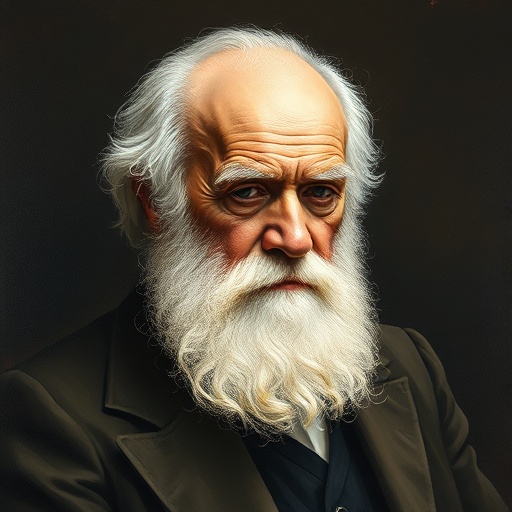
British naturalist whose On the Origin of Species (1859) established evolution by natural selection — the unifying theory of modern biology. Closely associated with Thomas Henry Huxley (his 'bulldog' public defender) and Alfred Russel Wallace (independent co-discoverer of natural selection). For an intellectual contrast, see William Paley, Anglican theologian and Natural Theology author (1743-1805) — Origin of Species is structurally a 400-page reply to Paley — Darwin admired Paley's watchmaker-argument as an undergraduate at Cambridge and then spent 20 years building the empirical machinery to displace him. The cleanest 'design argument vs natural selection' founding rebuttal in science.
The standard scholarly entry points to Charles Darwin's work: Janet Browne (Harvard, history of science) — Charles Darwin: Voyaging (1995) and The Power of Place (2002); Adrian Desmond (UCL, biographer) — Darwin: The Life of a Tormented Evolutionist (1991, with James Moore). These are the works graduate seminars cite when teaching Charles Darwin.
Found in 1 providers: grok
1 source checked
Repeated, consistent falsehoods accumulate enormous persuasive force through sheer persistence rather than logical merit. A misrepresentation need not be dramatic to be dangerous—if sustained steadily, it reshapes how people understand an idea, person, or movement. Truth, however carefully documented, can lose ground to deliberate distortion simply because the distortion keeps repeating. Repetition, not accuracy, becomes the decisive factor in what large numbers of people ultimately believe.
Darwin spent decades watching natural selection systematically misrepresented—critics falsely claimed he argued humans descended directly from apes, or that evolution denied morality entirely. Church leaders, politicians, and rival naturalists amplified these caricatures. Despite meticulous documentation in Origin of Species and The Descent of Man, he watched relentless distortion shape public perception more powerfully than his actual arguments. His frustration with this dynamic produced this sharp insight about how sustained misrepresentation defeats even rigorous evidence.
Victorian England's 1860s–1870s were a battleground between scientific naturalism and religious orthodoxy. Before scientific consensus was widely institutionalized, the press, pulpit, and Parliament shaped public understanding of nature. Darwin's theory entered a world where bishops commanded audiences of millions and newspapers sensationalized science. Without modern fact-checking norms, persistent misrepresentation—from caricatures of the 'monkey theory' to claims evolution bred godlessness—could dominate public discourse for years entirely unchallenged by corrective mechanisms.
AI-generated insights based on extensive research and information for context. Factual errors? Email [email protected].
Your cart is empty