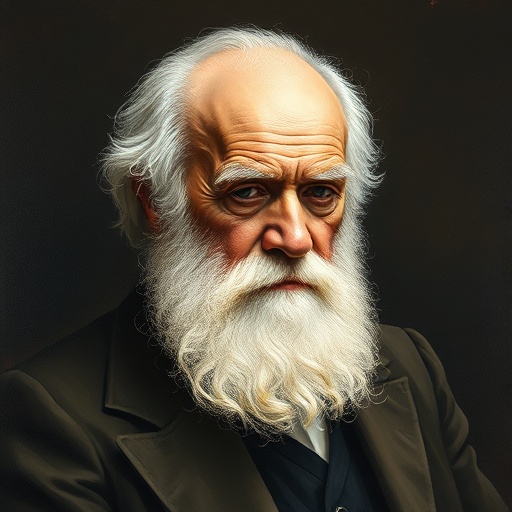
Charles Darwin — "A dog might as well speculate on the mind of Newton."
A dog might as well speculate on the mind of Newton.
A dog might as well speculate on the mind of Newton.
Click any product to generate a realistic preview. Up to 3 at a time.
* Initial load can take up to 90 seconds — revising the preview in another color is nearly instant.
"As a proof of the admirable power of the mind, I may mention that I have been for some years training my mind to reject the evidence of my senses when they do not square with my preconceived notions."
"If a man were to read a book on the cultivation of fruit trees, and then attempt to practice it without having seen a single tree, he would not be more unsuccessful than those who attempt to philosoph…"
"My mind seems to have become a kind of machine for grinding general laws out of large collections of facts, but why this should have caused the atrophy of that part of the brain alone, on which the hi…"
"I have felt a considerable reluctance to express myself in this chapter on the subject of religion."
"I have tried to be a good boy, and I have done my best."
British naturalist whose On the Origin of Species (1859) established evolution by natural selection — the unifying theory of modern biology. Closely associated with Thomas Henry Huxley (his 'bulldog' public defender) and Alfred Russel Wallace (independent co-discoverer of natural selection). For an intellectual contrast, see William Paley, Anglican theologian and Natural Theology author (1743-1805) — Origin of Species is structurally a 400-page reply to Paley — Darwin admired Paley's watchmaker-argument as an undergraduate at Cambridge and then spent 20 years building the empirical machinery to displace him. The cleanest 'design argument vs natural selection' founding rebuttal in science.
The standard scholarly entry points to Charles Darwin's work: Janet Browne (Harvard, history of science) — Charles Darwin: Voyaging (1995) and The Power of Place (2002); Adrian Desmond (UCL, biographer) — Darwin: The Life of a Tormented Evolutionist (1991, with James Moore). These are the works graduate seminars cite when teaching Charles Darwin.
Expressing the profound limits of human understanding, particularly in theological matters.
Date: Approximate
WisdomFound in 1 providers: gemini
1 source checked
The quote captures human intellectual humility about ultimate questions — specifically whether humans can truly comprehend God or cosmic origins. Just as a dog cannot grasp Newton's mathematics, humans may be neurologically incapable of understanding metaphysical truths beyond our evolved cognitive reach. Darwin isn't dismissing the questions; he's suggesting our brains, shaped by natural selection for survival rather than cosmic truth-seeking, may be fundamentally unequipped to answer them.
Darwin wrestled with religion his entire life, losing faith gradually — accelerated by daughter Annie's death in 1851. He ultimately identified as agnostic, requiring intellectual honesty about the limits of human knowledge. This quote embodies that stance: invoking Newton, history's supreme scientific intellect, as a benchmark only a dog would presume to surpass, then applying identical humility to humanity facing God. It's Darwin's own evolutionary logic turned inward on the human mind.
Victorian England was engulfed in the science-versus-religion debate Darwin's work ignited. The 1860 Oxford clash between Huxley and Bishop Wilberforce symbolized the era's rupture. Newton remained the supreme icon of human reason, his physics dominant for 150 years. Darwin's quote acknowledges both that reverence for Newtonian intellect and the Victorian theological crisis, positioning human minds between God and dog in a way that simultaneously disturbed clergy and fascinated the era's growing agnostic intellectuals.
AI-generated insights based on extensive research and information for context. Factual errors? Email [email protected].
Your cart is empty