Zoroaster — "He who cherishes the Lie, him Ahura Mazda will destroy."
He who cherishes the Lie, him Ahura Mazda will destroy.
He who cherishes the Lie, him Ahura Mazda will destroy.
Click any product to generate a realistic preview. Up to 3 at a time.
* Initial load can take up to 90 seconds — revising the preview in another color is nearly instant.
"May your heart be full of love and your pockets full of... well, whatever you like."
"Evil is connected to lie or drûj. The Avestan word drûj means literally 'a tangle of trickery, deceit and lies.' Evil is what is not original and real."
"The path of Good Thought leads to the Best Existence."
"Aša Vahišta (Best Righteousness) is the best of all things, and happiness is to him who is righteous for the sake of Righteousness."
"I try, O Mazda, through the radiance of wisdom to know You. You who are the creator of existence."
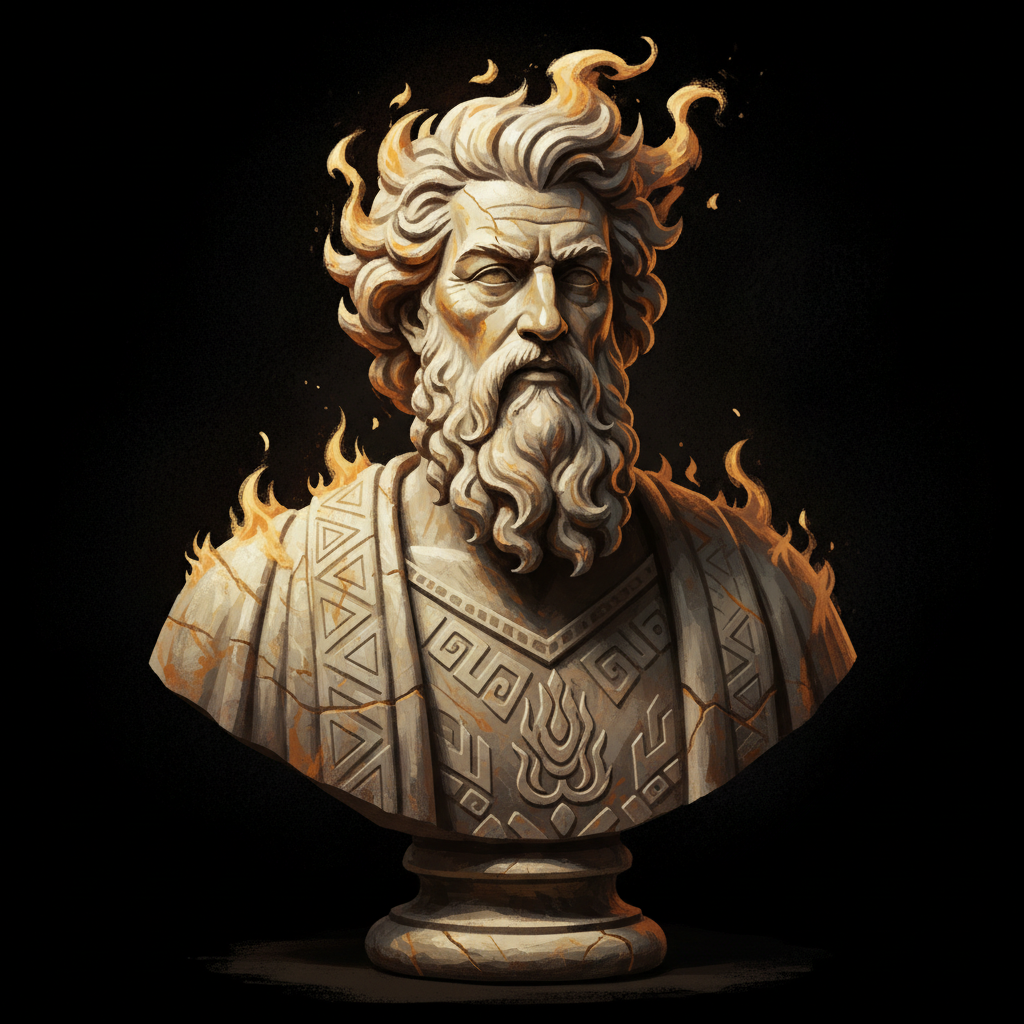
Iranian prophet who founded Zoroastrianism, the first major religion of cosmic dualism between good (Ahura Mazda) and evil (Angra Mainyu). Closely associated with The Buddha (near-contemporary Eastern moral-cosmological revolutionary). For an intellectual contrast, see Friedrich Nietzsche, German philosopher of 'beyond good and evil' — Nietzsche appropriated Zarathustra's name for Thus Spoke Zarathustra (1883) precisely to invert the original's moral cosmology — the historical Zoroaster founded the good-versus-evil framework Nietzsche's character announces the end of.
Found in 1 providers: grok
1 source checked
Anyone who embraces deception, falsehood, or deceit will face destruction at the hands of the supreme god. The quote draws a sharp line between truth and lies, warning that dishonesty is not just a personal flaw but a cosmic offense. Living by falsehood puts you on the losing side of a universal moral order, where the divine actively opposes and ultimately eliminates those who choose deceit.
Zoroaster built his entire religion around the cosmic battle between Asha (truth, order) and Druj (the Lie, chaos). As a prophet-reformer, he rejected the polytheism of his society and declared Ahura Mazda the sole supreme god who rewards truth and punishes falsehood. This quote distills his core teaching: moral choice between truth and lie defines human destiny, a framework that shaped his prophetic mission.
Zoroaster lived in ancient Persia, likely between 1500-1000 BCE, amid tribal polytheism, blood sacrifices, and warrior cults that glorified raiding. By naming 'the Lie' as the supreme evil, he challenged a society where deception, broken oaths, and cattle-raiding were common. His ethical monotheism was revolutionary, later influencing Judaism, Christianity, and Islam's concepts of heaven, hell, judgment, and the cosmic struggle between good and evil.
AI-generated insights based on extensive research and information for context. Factual errors? Email [email protected].
Your cart is empty