Laozi — "He who controls others may be powerful, but he who has mastered himself is might…"
He who controls others may be powerful, but he who has mastered himself is mightier still.
He who controls others may be powerful, but he who has mastered himself is mightier still.
Click any product to generate a realistic preview. Up to 3 at a time.
* Initial load can take up to 90 seconds — revising the preview in another color is nearly instant.
"The truth is not always beautiful, nor beautiful words the truth."
"The best way to manage is to manage very little."
"The highest good is like water. It nourishes all things without trying to."
"Without going outside, you may know the whole world."
"The sage has no mind of his own. He takes the mind of the people as his mind."
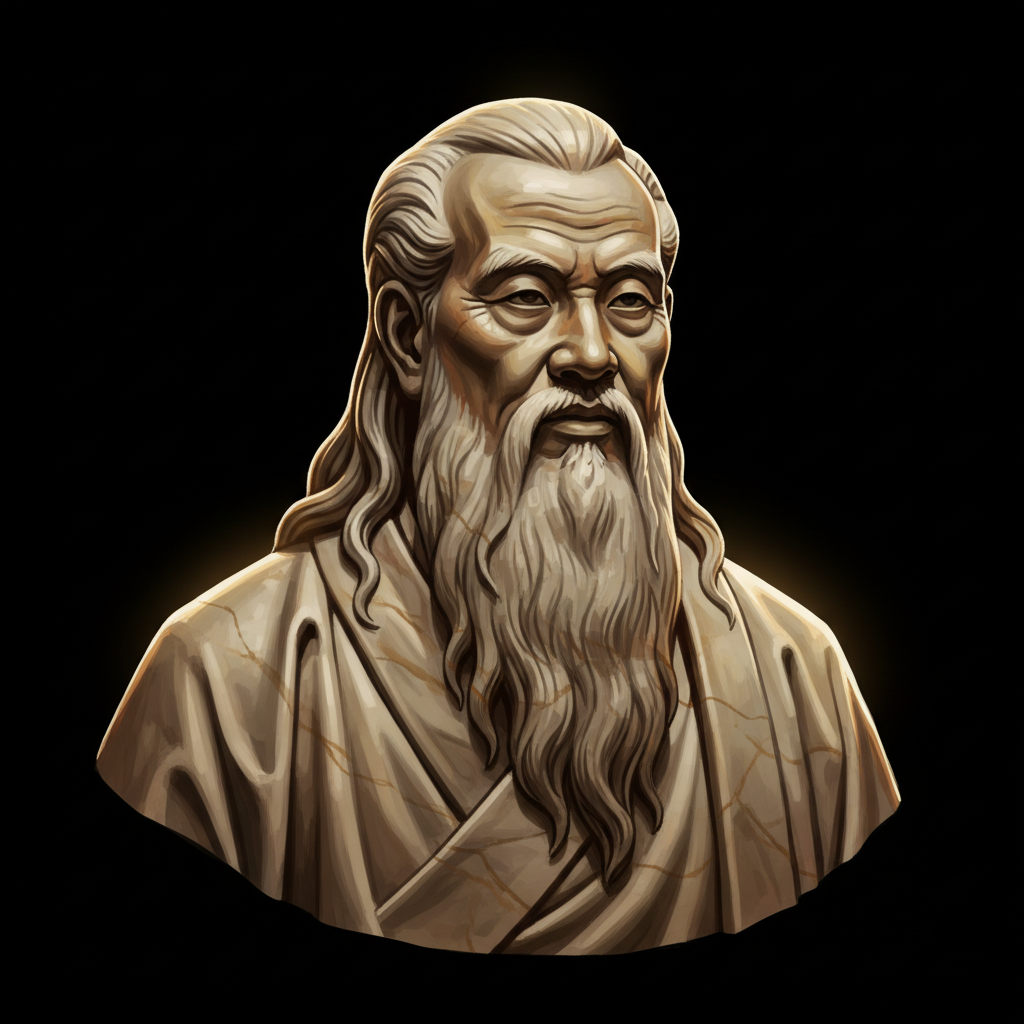
Reputed founder of Taoism and author of the Tao Te Ching, whose wu wei (effortless action) shaped East Asian philosophy. Closely associated with Zhuangzi (later Taoist who extended Laozi's framework). For an intellectual contrast, see Confucius, near-contemporary Chinese sage of social ritual and duty — Confucius systematized social order through ritual and hierarchy; Laozi argued that all such systems were the disease, not the cure — the two founding poles of Chinese moral philosophy.
Found in 2 providers: grok,gemini
2 sources checked
Real strength is not about dominating others but about governing your own impulses, fears, and desires. Anyone with enough force, position, or cleverness can push people around, but that kind of power depends on outside circumstances and can vanish. The harder, more lasting achievement is ruling yourself: staying calm under pressure, resisting cravings, and acting with discipline. A person who has done that holds a steadier, deeper power than any ruler controlling others.
Laozi taught that true strength comes from inner stillness and yielding rather than force, which is the heart of Taoism. Tradition says he served as a keeper of royal archives, watching ambitious officials rise and fall through scheming and conquest. Disillusioned, he reportedly left society to live simply. His Tao Te Ching repeatedly contrasts external dominance with self-mastery, urging rulers to govern themselves before others, making this saying a direct echo of his lived philosophy.
Laozi lived during the late Zhou dynasty, an era of fracturing royal authority and constant warfare between rival Chinese states. Warlords gained power through armies, intrigue, and harsh Legalist control, while ordinary people suffered. Competing schools like Confucianism stressed social order through ritual, and Legalism through punishment. Against this backdrop of rulers obsessed with controlling territory and subjects, Laozi's emphasis on self-mastery offered a radical alternative: stable power begins inside the person, not in conquest.
AI-generated insights based on extensive research and information for context. Factual errors? Email [email protected].
Your cart is empty