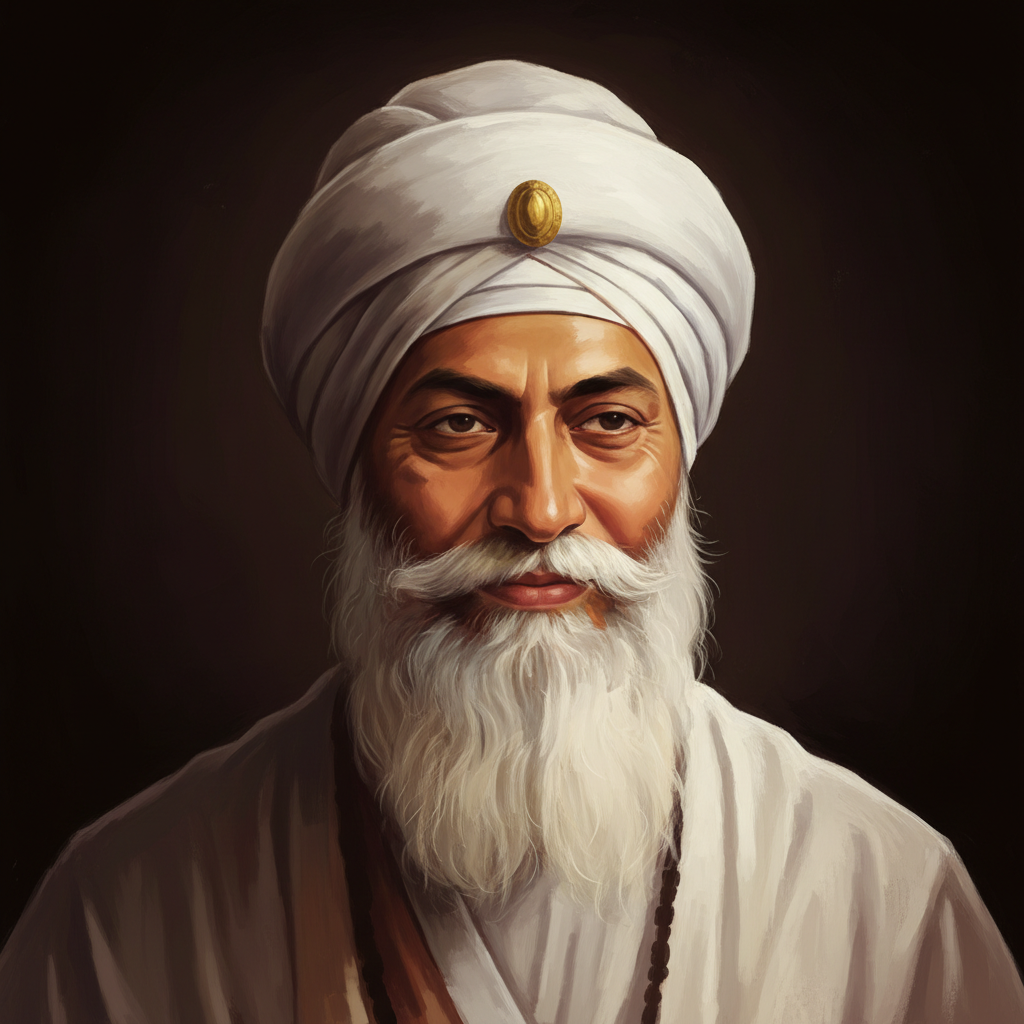
Guru Nanak — "He who has conquered his mind has conquered the world."
He who has conquered his mind has conquered the world.
He who has conquered his mind has conquered the world.
Click any product to generate a realistic preview. Up to 3 at a time.
* Initial load can take up to 90 seconds — revising the preview in another color is nearly instant.
"To conquer the mind is to conquer the world."
"Caste has no power in the hereafter; the only judge is truth."
"Do not wish evil for others. Do not speak ill of others. Do not obstruct anyone's activities."
"The mind is a mad elephant, intoxicated by ego. Only the Guru's teachings can tame it."
"Na Ham Hindu Na Musalmaan - I am not a Hindu, nor am I a Muslim."
Founder of Sikhism and the first of the Ten Sikh Gurus, whose teachings of one universal God and rejection of caste shaped Punjab. Closely associated with Kabir (mystical poet whose verses appear in the Sikh Guru Granth Sahib). For an intellectual contrast, see Brahmanical orthodoxy, the Hindu caste-and-ritual establishment of his era — Sikhism was founded as a deliberate alternative to both Hindu ritual hierarchy and Islamic exclusivism — Nanak's universalism was a structural rejection of caste and priestly mediation.
Found in 1 providers: grok
1 source checked
Real power is not about controlling other people, money, or events, but about mastering your own thoughts, desires, fears, and reactions. Someone who can govern anger, greed, pride, and impulse is effectively unshakeable, because external circumstances lose their grip once the inner response is disciplined. In modern terms, self-regulation is the ultimate form of success: win the internal battle, and nothing outside can truly defeat you.
Guru Nanak, founder of Sikhism, taught that liberation comes through inner discipline, honest living, and remembrance of the one divine reality, not through rituals, caste, or conquest. He rejected external status markers and emphasized haumai (ego) as the root of suffering. Having traveled widely as a spiritual teacher rather than a ruler or warrior, his notion of victory was explicitly internal: subduing ego and desire, which he considered the truest mastery a human being could achieve.
Guru Nanak lived 1469–1539 in Punjab during Mughal expansion under Babur, amid entrenched Hindu caste hierarchy and Islamic political dominance. Religious identity was weaponized, rituals were commercialized by priests, and ordinary people were squeezed between competing orthodoxies and invading armies. In this climate of outward conflict and coerced conformity, redirecting attention to inner conquest was radical: it bypassed caste, clergy, and sultan alike, offering dignity and agency to anyone regardless of birth or political circumstance.
AI-generated insights based on extensive research and information for context. Factual errors? Email [email protected].
Your cart is empty