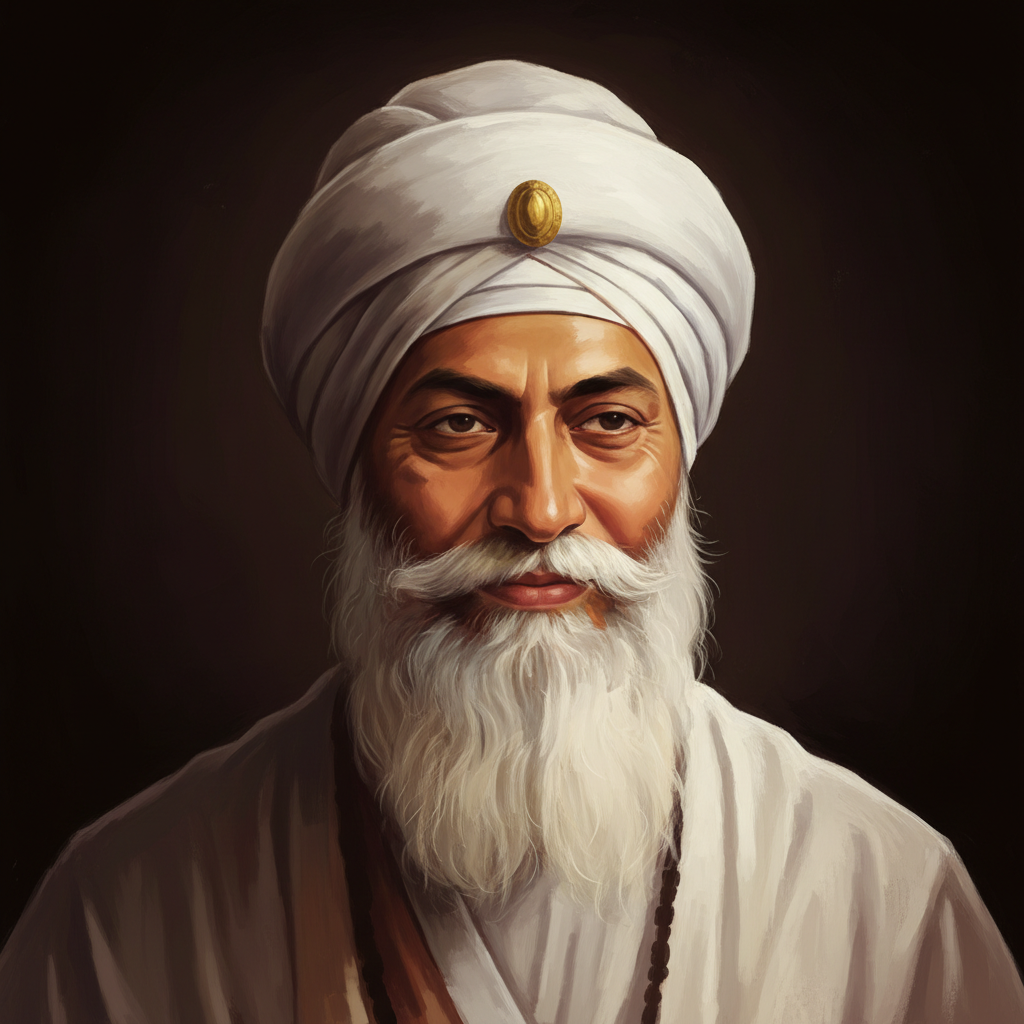
Guru Nanak — "He who has no enemies, and is without hatred, and who sees God in all beings, he…"
He who has no enemies, and is without hatred, and who sees God in all beings, he is a true saint.
He who has no enemies, and is without hatred, and who sees God in all beings, he is a true saint.
Click any product to generate a realistic preview. Up to 3 at a time.
* Initial load can take up to 90 seconds — revising the preview in another color is nearly instant.
"The Lord dwells in every heart; why search for Him outside?"
"Emotional attachment to Maya is totally painful, this is a bad bargain."
"There is but One God. His Name is Truth; He is the Creator, Sustainer of all, Free from fear and hate, Immortal, Unborn, Self-existent, Realized by the Guru's Grace."
"May your days be blessed and your phone battery never die mid-conversation."
"By His Command, all forms came into being, by His Command, life descended into them."
Founder of Sikhism and the first of the Ten Sikh Gurus, whose teachings of one universal God and rejection of caste shaped Punjab. Closely associated with Kabir (mystical poet whose verses appear in the Sikh Guru Granth Sahib). For an intellectual contrast, see Brahmanical orthodoxy, the Hindu caste-and-ritual establishment of his era — Sikhism was founded as a deliberate alternative to both Hindu ritual hierarchy and Islamic exclusivism — Nanak's universalism was a structural rejection of caste and priestly mediation.
Found in 1 providers: gemini
1 source checked
A genuine holy person is recognized not by rituals or titles but by inner freedom from hostility. They hold no grudges, treat no one as an opponent, and refuse to see others as obstacles. Instead, they perceive a single divine presence within every living being, which makes cruelty or exclusion impossible. Spirituality, in this view, is measured by how you treat people, especially those you might otherwise dismiss or resent.
Guru Nanak founded Sikhism around 1500 by rejecting caste divisions and the Hindu-Muslim hostility dominant in Punjab. His famous declaration 'there is no Hindu, no Muslim' insisted on one humanity under one divine creator, Ik Onkar. He traveled extensively preaching equality, established the communal langar meal where all castes ate together, and chose companions from both faiths. This saying distills his lived practice: true devotion meant seeing God everywhere and refusing inherited hatreds.
Guru Nanak lived 1469-1539 in Punjab under the Lodi Sultanate and early Mughal conquest by Babur, a turbulent region where Hindu-Muslim tensions, caste rigidity, and ritual-heavy Brahminical religion defined daily life. Sectarian violence and social exclusion were common. Bhakti and Sufi movements were simultaneously challenging orthodoxy with devotional, personal approaches to God. In this climate, preaching universal brotherhood and divine immanence in every person was radical, directly threatening caste hierarchies and religious boundaries that structured power.
AI-generated insights based on extensive research and information for context. Factual errors? Email [email protected].
Your cart is empty