Guru Nanak — "There is but One God. His Name is Truth; He is the Creator, Sustainer of all, Fr…"

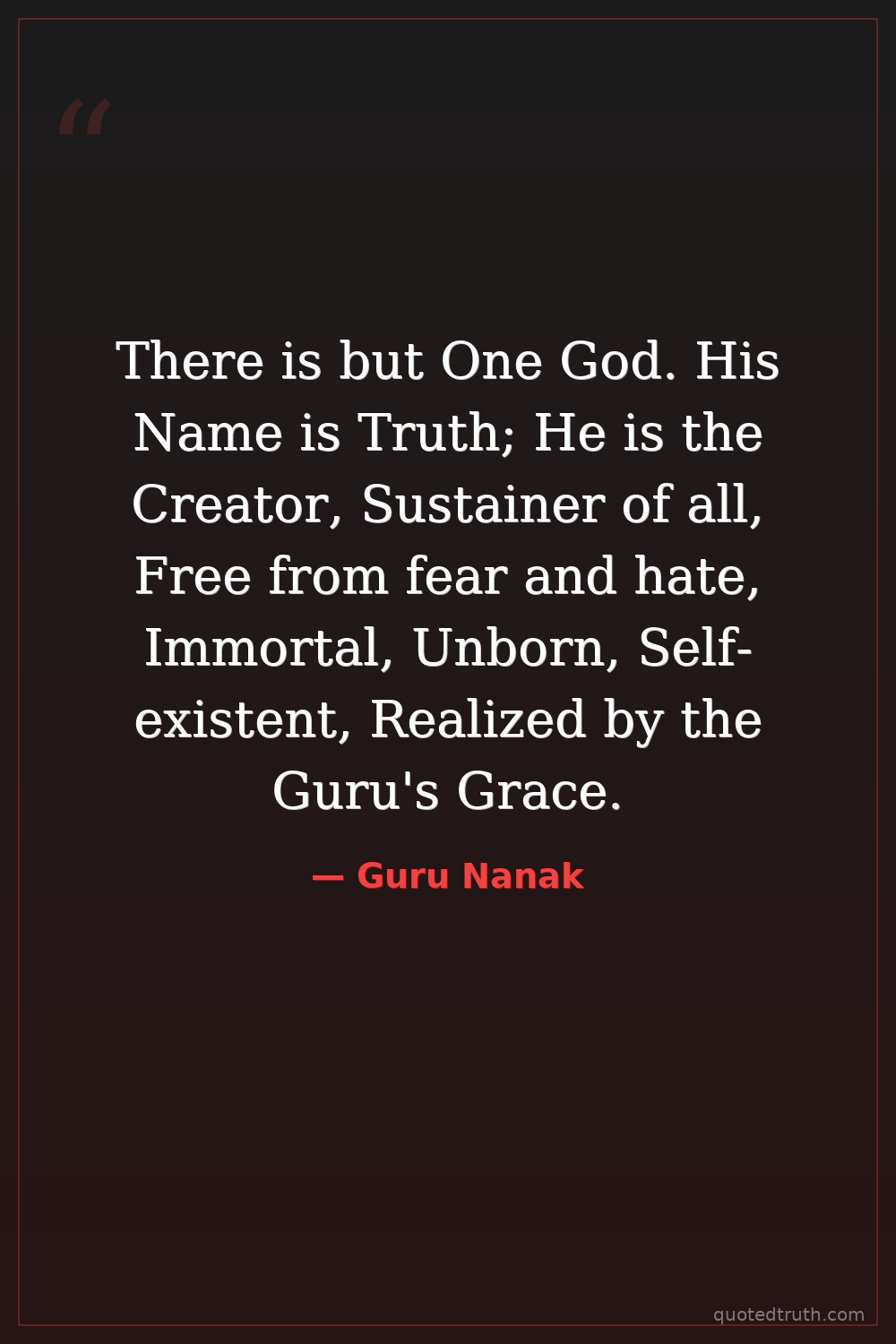
There is but One God. His Name is Truth; He is the Creator, Sustainer of all, Free from fear and hate, Immortal, Unborn, Self-existent, Realized by the Guru's Grace.
Guru Nanak — Guru Nanak Early Modern · Founder of Sikhism

Get This Quote & Author's Image Illustrated On:

Click any product to generate a realistic preview. Up to 3 at a time.
* Initial load can take up to 90 seconds — revising the preview in another color is nearly instant.

Kitchen

Apparel

Other

About Guru Nanak (1469-1539)

Founder of Sikhism and the first of the Ten Sikh Gurus, whose teachings of one universal God and rejection of caste shaped Punjab. Closely associated with Kabir (mystical poet whose verses appear in the Sikh Guru Granth Sahib). For an intellectual contrast, see Brahmanical orthodoxy, the Hindu caste-and-ritual establishment of his era — Sikhism was founded as a deliberate alternative to both Hindu ritual hierarchy and Islamic exclusivism — Nanak's universalism was a structural rejection of caste and priestly mediation.

Details

Mool Mantar, Japji Sahib

Date: 15th-16th century

Social & Racial

Verification

Unverifiable

Found in 1 providers: grok

1 source checked

Understanding this quote

What it means

One universal God exists, defined not by religion or ritual but by truth itself. This God creates and sustains everything without fear, hatred, or the limitations of birth and death. Humans cannot reach this God through cleverness or status alone — only through the guidance of an enlightened teacher can a person genuinely experience this divine reality.

Relevance to Guru Nanak

Guru Nanak spent decades traveling across South Asia, the Middle East, and Central Asia challenging both Hindu caste hierarchies and Islamic orthodoxy. This opening verse of the Guru Granth Sahib, called the Mool Mantar, distills his life's mission: replacing ritualistic religion with direct, egalitarian devotion to one formless God accessible to every person regardless of birth.

The era

In 15th–16th century Punjab, Hindu-Muslim tensions ran high under Mughal expansion and Lodi Sultanate rule. Caste discrimination rigidly divided Hindu society while Islamic governance imposed its own hierarchies. Guru Nanak's declaration of one universal God without caste, creed, or priestly gatekeeping was radically democratic and spiritually unifying in a region fractured by competing religious identities.

AI-generated insights based on extensive research and information for context. Factual errors? Email [email protected].
Your Cart

Your cart is empty