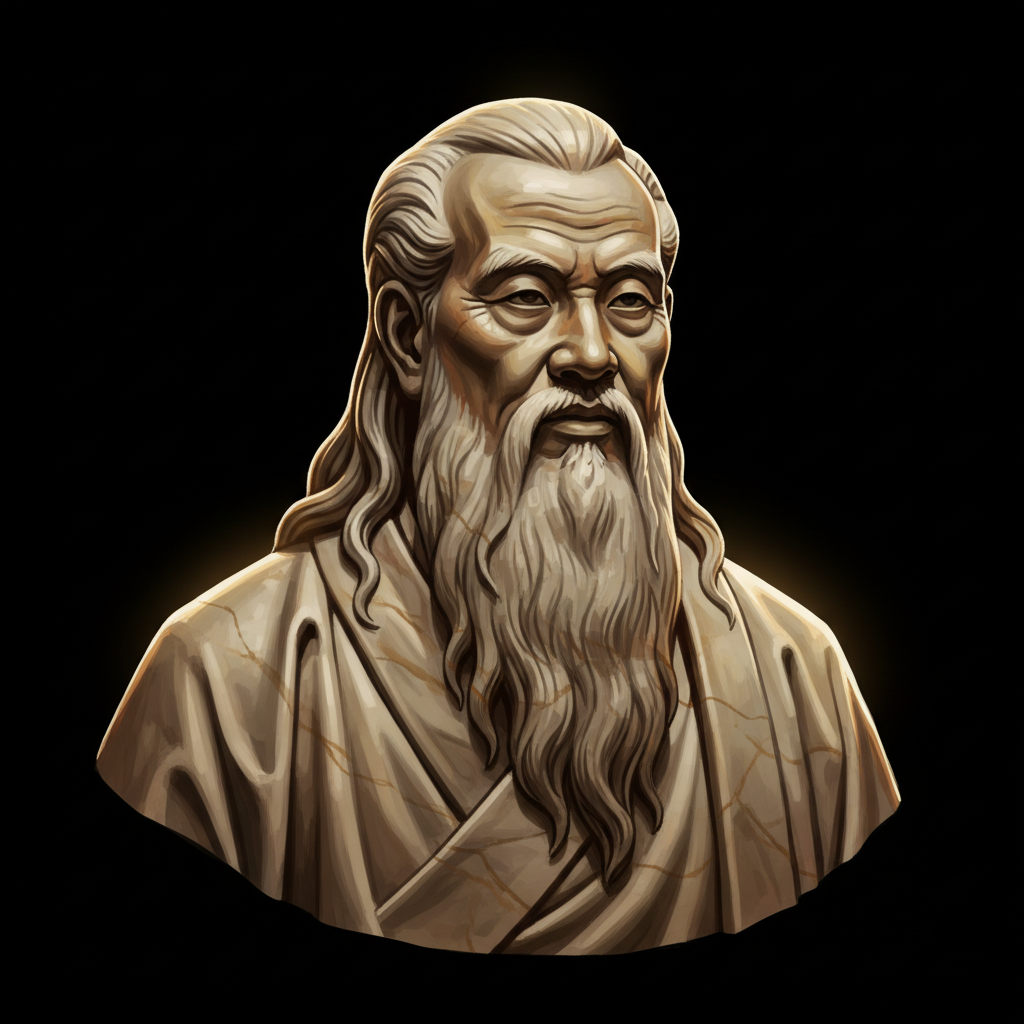
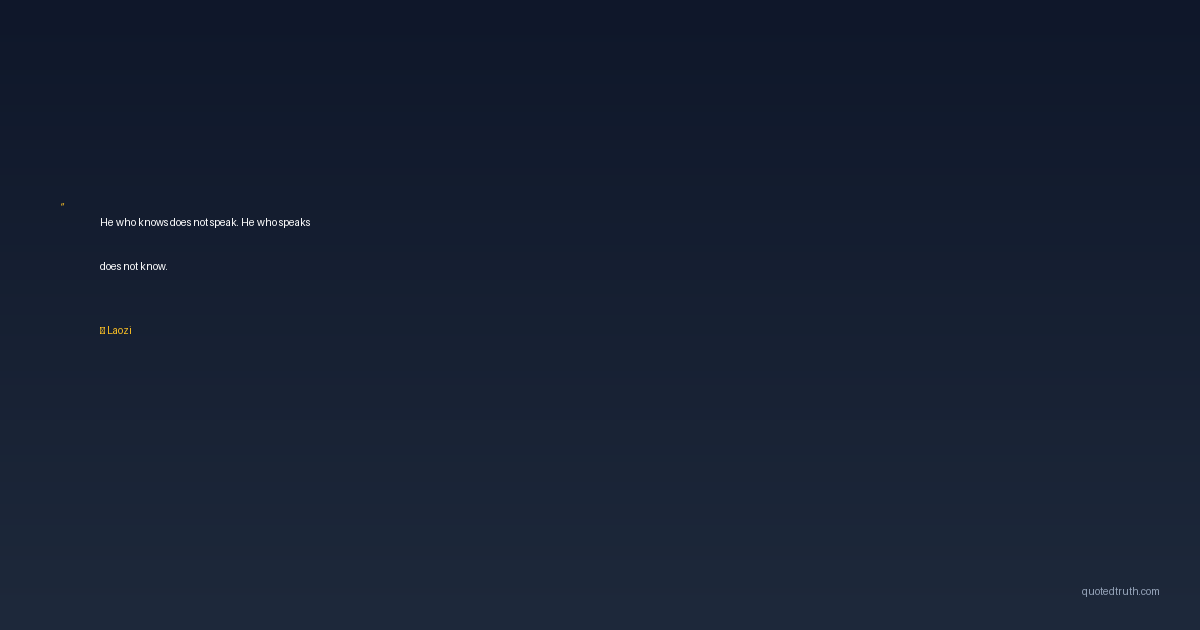
Laozi — "He who knows does not speak. He who speaks does not know."
He who knows does not speak. He who speaks does not know.
He who knows does not speak. He who speaks does not know.
Click any product to generate a realistic preview. Up to 3 at a time.
* Initial load can take up to 90 seconds — revising the preview in another color is nearly instant.
"If a nation is to be great, it must be like a great river, it must flow freely in every direction."
"The reason why the river and the sea are able to be the lords of the hundred valleys is that they excel in taking the lower position. That is why they are able to be the lords of the hundred valleys."
"He who is attached to things will suffer much."
"Empty your mind of all thoughts. Let your heart be at peace. Watch the turmoil of the world, but let your serenity remain intact."
"Fill your bowl to the brim and it will spill. Keep sharpening your knife and it will blunt."
Reputed founder of Taoism and author of the Tao Te Ching, whose wu wei (effortless action) shaped East Asian philosophy. Closely associated with Zhuangzi (later Taoist who extended Laozi's framework). For an intellectual contrast, see Confucius, near-contemporary Chinese sage of social ritual and duty — Confucius systematized social order through ritual and hierarchy; Laozi argued that all such systems were the disease, not the cure — the two founding poles of Chinese moral philosophy.
Found in 3 providers: gemini,deepseek,grok
3 sources checked
Real understanding lives beyond words. Those who have actually grasped deep truth recognize that language flattens and distorts it, so they stay quiet or speak sparingly. People who talk endlessly, lecture, or broadcast their expertise usually reveal the opposite: surface knowledge dressed up as wisdom. Genuine insight is demonstrated through action, restraint, and presence, not through clever explanations. Talking about a thing is not the same as knowing it.
Laozi is the legendary founder of Taoism and traditional author of the Tao Te Ching, a text obsessed with the limits of language: its opening line declares that the Tao which can be named is not the eternal Tao. Legend says he worked as an archivist in the Zhou court and left silently on a water buffalo, only writing his book when a border guard demanded it. Reluctance to speak defined him.
Laozi is placed in the 6th–4th century BCE, during the Zhou dynasty's decline and the Warring States upheaval. Rival schools, Confucians, Mohists, Legalists, competed loudly with elaborate doctrines on ritual, governance, and moral speech. Wandering philosophers lectured rulers for patronage. Against this noisy marketplace of sages, Taoism's suspicion of rhetoric and preference for wu wei, effortless non-action, was a pointed rebuke of an era drowning in arguments.
AI-generated insights based on extensive research and information for context. Factual errors? Email [email protected].
Your cart is empty