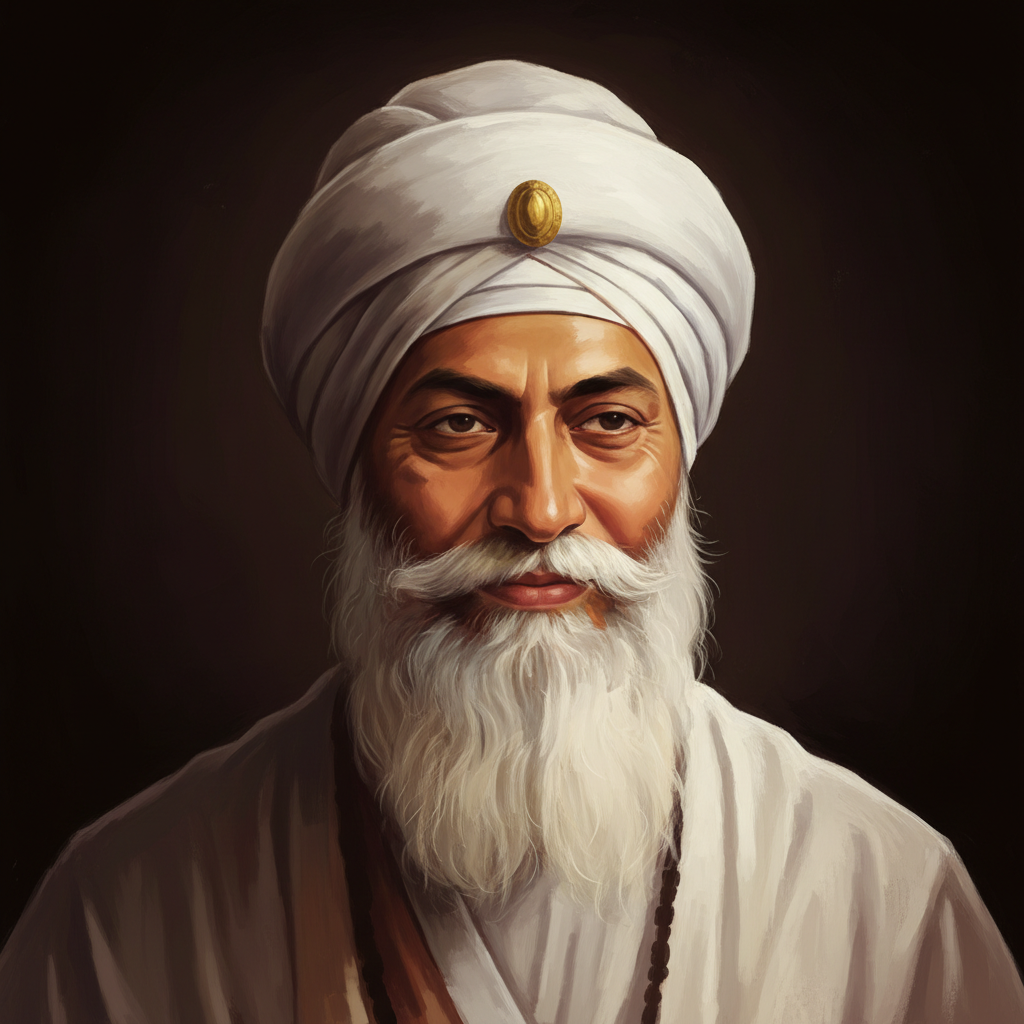
Guru Nanak — "Religion consists not in words; He who looks on all men as equal is religious."
Religion consists not in words; He who looks on all men as equal is religious.
Religion consists not in words; He who looks on all men as equal is religious.
Click any product to generate a realistic preview. Up to 3 at a time.
* Initial load can take up to 90 seconds — revising the preview in another color is nearly instant.
"Guru Nanak taught that depriving others of their rights is a serious moral offense."
"The whole creation is His temple."
"Whatever you do, do it with love. And a good soundtrack."
"With your hands carve out your own destiny."
"He who serves the Guru, he alone finds peace."
Founder of Sikhism and the first of the Ten Sikh Gurus, whose teachings of one universal God and rejection of caste shaped Punjab. Closely associated with Kabir (mystical poet whose verses appear in the Sikh Guru Granth Sahib). For an intellectual contrast, see Brahmanical orthodoxy, the Hindu caste-and-ritual establishment of his era — Sikhism was founded as a deliberate alternative to both Hindu ritual hierarchy and Islamic exclusivism — Nanak's universalism was a structural rejection of caste and priestly mediation.
Found in 1 providers: grok
1 source checked
True faith is not shown through rituals, sermons, or religious vocabulary. A person's spiritual worth is measured by how they treat others, specifically whether they see every human being as having equal value. Empty religious talk means nothing if it coexists with prejudice, hierarchy, or contempt. Real devotion shows up in behavior, in refusing to rank people by birth, class, gender, or creed, and treating all as one.
Guru Nanak founded Sikhism on exactly this principle, rejecting the caste system, Hindu-Muslim divisions, and ritual formalism of his time. He instituted langar, the communal kitchen where people of every caste eat together as equals, and traveled widely preaching that God sees no distinction between people. His opposition to empty ceremony and insistence on lived equality directly produced this teaching.
In late 15th and early 16th century Punjab, rigid Hindu caste hierarchy coexisted with Mughal-era Hindu-Muslim tension and performative ritualism on both sides. Brahmins controlled religious access, untouchables were segregated, and women held low status. Nanak lived through the Lodi Sultanate and Babur's 1526 invasion, witnessing religious violence firsthand. Declaring all humans equal was a direct challenge to caste, clerical authority, and communal divisions defining the subcontinent.
AI-generated insights based on extensive research and information for context. Factual errors? Email [email protected].
Your cart is empty