What it means
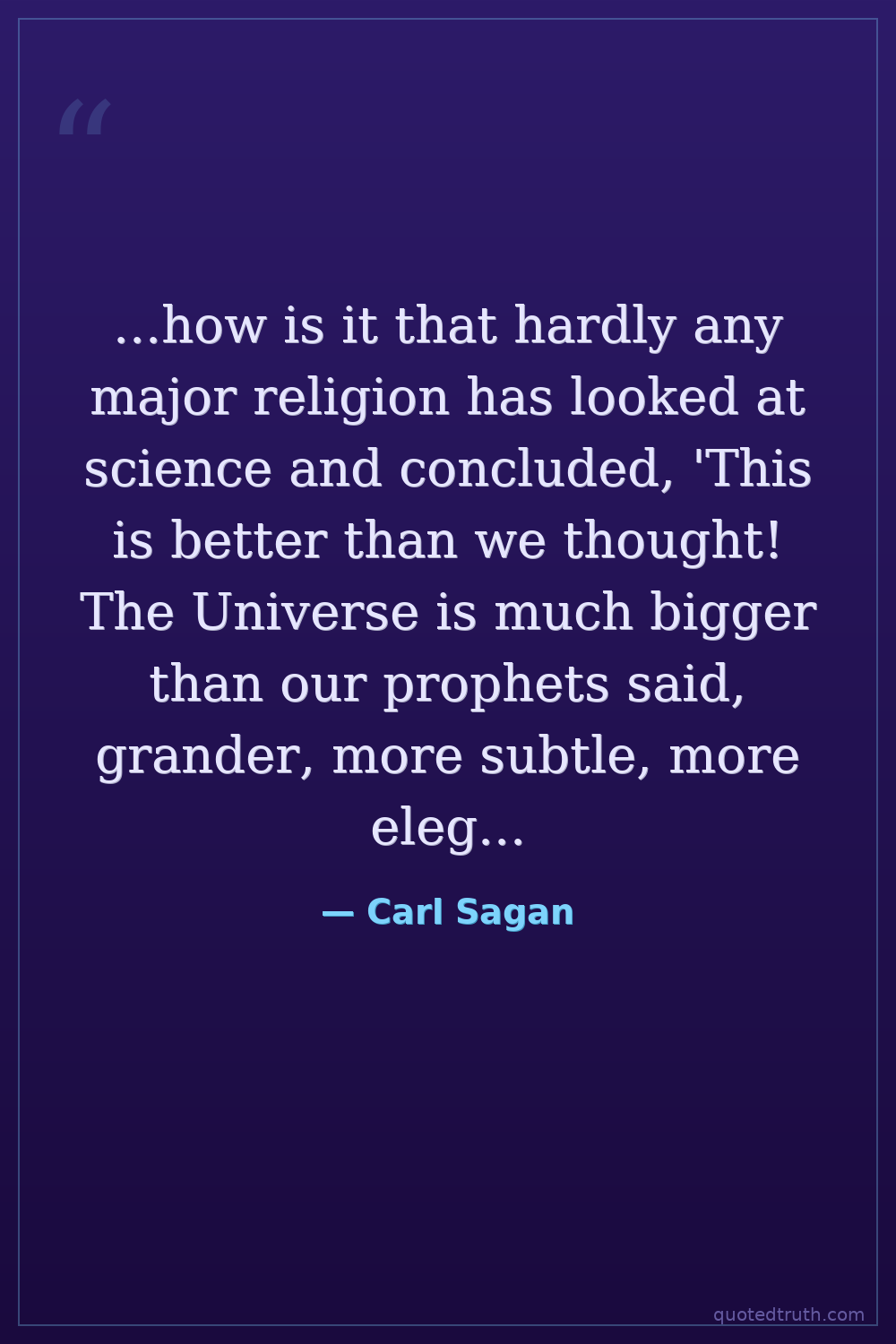
Sagan challenges organized religion's defensive posture toward science. Instead of feeling threatened when discoveries revealed a universe vaster and more intricate than ancient texts described, religious traditions could have responded with deeper wonder. He asks why scientific revelation—galaxies, deep time, cosmic scale—wasn't embraced as confirmation that creation exceeds what prophets imagined, making the sacred grander rather than diminished.
Relevance to Carl Sagan
Sagan spent his career bridging scientific wonder and public understanding. As the astronomer who described Earth as a pale blue dot suspended in a sunbeam, he felt profound awe at cosmic scale. He was not anti-religious by nature but deeply troubled by dogmatism resisting evidence. His work on SETI and planetary science made him acutely conscious of how narrow human assumptions looked against the actual universe.
The era
The late 20th century saw escalating tension between religious fundamentalism and evolutionary science, especially through creationism battles in American classrooms. The Hubble Space Telescope, launched in 1990, was revealing a universe of hundreds of billions of galaxies. Sagan wrote amid the 1980s-90s culture wars, when creationist movements sought equal curricular standing and scientific literacy was declining, making his appeal to religious awe of science a direct counter-response.
AI-generated insights based on extensive research and information for context. Factual errors? Email [email protected].