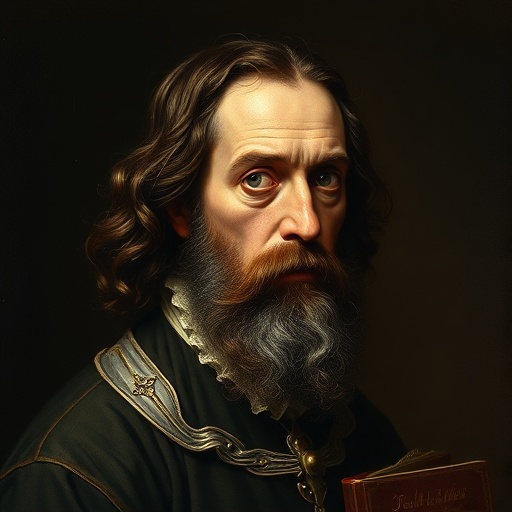
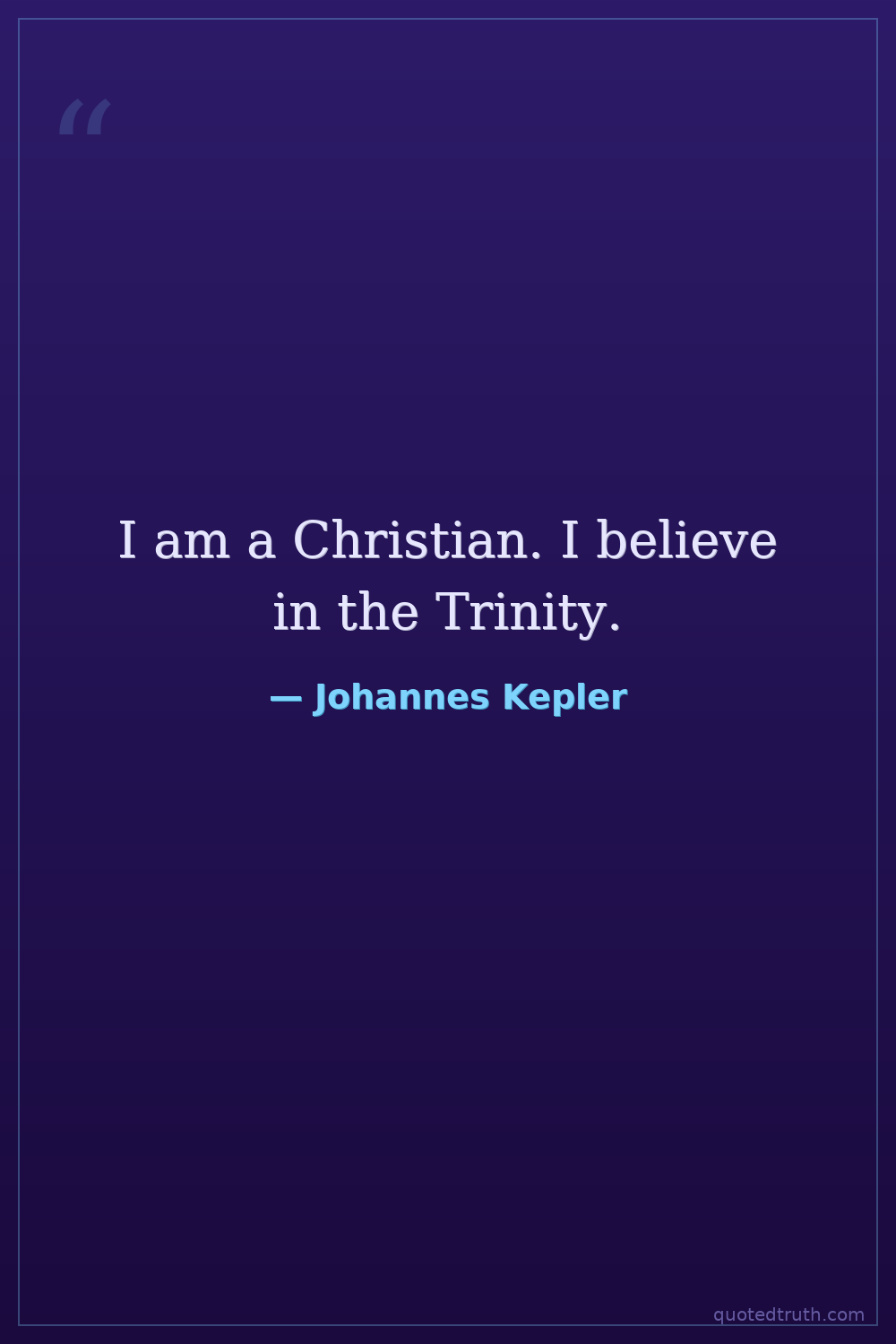
Johannes Kepler — "I am a Christian. I believe in the Trinity."
I am a Christian. I believe in the Trinity.
I am a Christian. I believe in the Trinity.
Click any product to generate a realistic preview. Up to 3 at a time.
* Initial load can take up to 90 seconds — revising the preview in another color is nearly instant.
"I have been a mortal, and I have faced my own mortality with courage."
"My goal is to show that the heavenly machine is not a kind of divine living being but similar to a clockwork insofar as all the manifold motions are taken care of by one single absolutely simple magne…"
"So long as the mother, Ignorance, lives, it is not safe for Science, the offspring, to divulge the hidden causes of things."
"I much prefer the sharpest criticism of a single intelligent man to the thoughtless approval of the masses."
"For a long time I was restless. Now, however, behold how through my effort God is being celebrated in astronomy."
Found in 1 providers: grok
1 source checked
The speaker openly declares their religious identity, affirming belief in Christianity and specifically the doctrine of the Trinity—the idea that God exists as three persons: Father, Son, and Holy Spirit. It is a simple, direct statement of personal faith rather than an argument or defense, making clear where the speaker stands on core theological questions without hedging or qualification.
Kepler was a devout Lutheran whose faith drove his scientific work; he saw discovering planetary laws as reading God's mathematical blueprint for creation. He studied theology at Tübingen before turning to astronomy and refused to convert to Catholicism even when excommunicated from Lutheran communion over Eucharist disputes, losing jobs and suffering exile rather than compromise his Trinitarian convictions.
Early 17th-century Europe was convulsed by the Thirty Years' War (1618-1648), a brutal Catholic-Protestant conflict. Religious identity determined employment, citizenship, and survival. The Counter-Reformation pressured Protestants to convert, while Lutheran and Calvinist factions feuded over sacramental theology. Declaring specific Trinitarian belief situated one precisely within this dangerous sectarian landscape, where astronomers like Kepler navigated patronage from both Catholic emperors and Protestant princes.
AI-generated insights based on extensive research and information for context. Factual errors? Email [email protected].
Your cart is empty