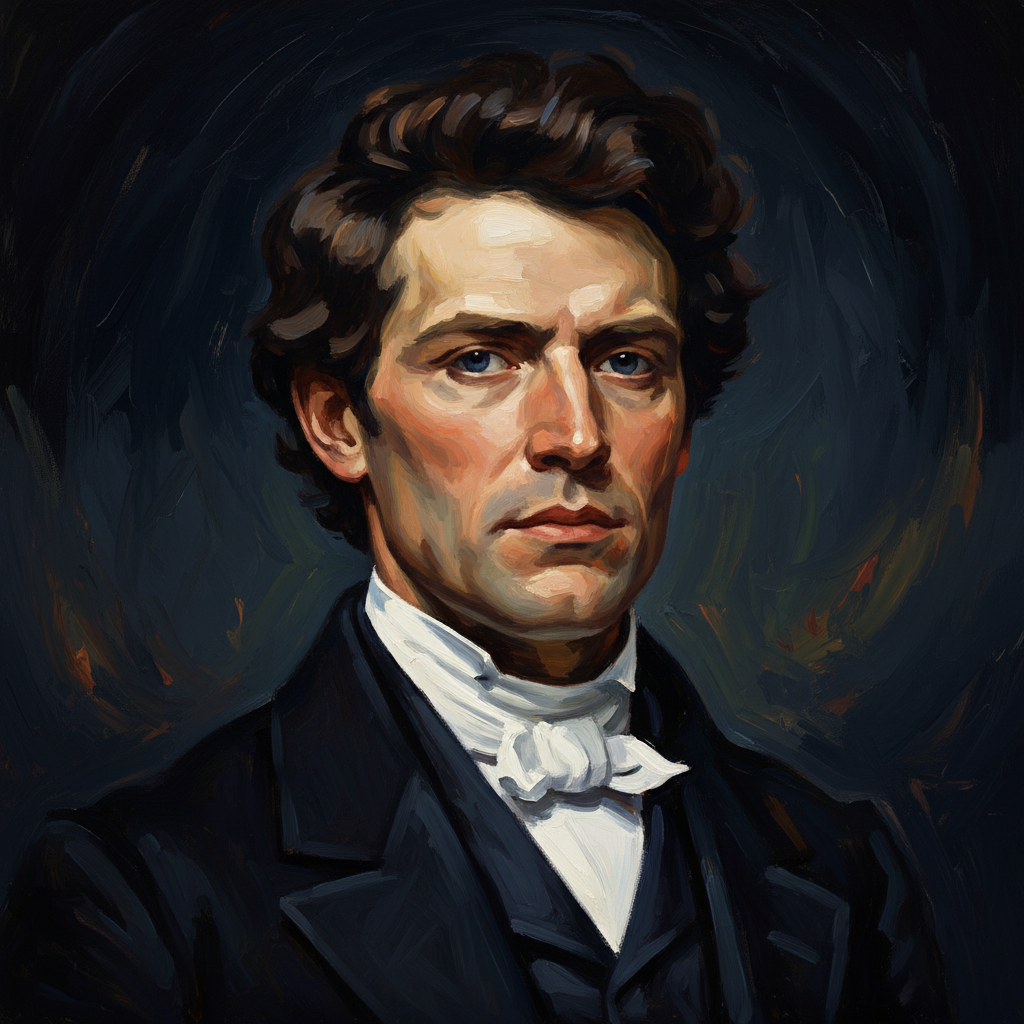
Joseph Smith — "I am a friend to the whole human race."
I am a friend to the whole human race.
I am a friend to the whole human race.
Click any product to generate a realistic preview. Up to 3 at a time.
* Initial load can take up to 90 seconds — revising the preview in another color is nearly instant.
"I told the brethren that the Book of Mormon was the most correct of any book on earth, and the keystone of our religion, and a man would get nearer to God by abiding by its precepts, than by any other…"
"I am a chosen vessel of the Lord to do a great work."
"I defy all the world to find a passage in the Bible where the Lord says that He ever authorized a man to make a king, or a priest, or even a prophet, without first giving him a vision or by the minist…"
"I calculated to be one of the instruments of setting up the kingdom of Daniel by the word of the Lord, and I intended to lay a foundation that would revolutionize the whole world."
"I am a lover of the Constitution, and I believe in the principles of republicanism."
Found in 1 providers: grok
1 source checked
A declaration of universal goodwill — the speaker claims no enemies and no tribal loyalties that exclude others. It asserts solidarity with all people regardless of background, belief, or circumstance. In modern terms: I am on everyone's side. It rejects the in-group versus out-group thinking common in politics and religion, positioning the speaker as someone whose compassion and commitment extend to all of humanity, not just a chosen community.
Smith built a religion centered on gathering and community, teaching that every soul carries immense worth. His 1844 U.S. presidential campaign championed abolishing slavery, prison reform, and national unity — radical stances embodying cross-cultural goodwill. As founder of Nauvoo, Illinois, he built a city welcoming diverse converts worldwide. Despite fierce persecution — Missouri's extermination order and eventual martyrdom in 1844 — Smith consistently framed himself as a unifier rather than a sectarian, making this declaration central to his identity.
America in the 1820s–1840s was fractured by sectarian religious rivalry, slavery debates, and violent frontier conflicts. The Second Great Awakening spawned competing denominations that viewed each other with open hostility. Mormons faced state-sanctioned persecution, including Missouri's 1838 extermination order. In that climate, claiming friendship with the whole human race was a bold rejection of tribalism and a direct appeal for tolerance in a society actively tearing itself apart along religious, racial, and political lines.
AI-generated insights based on extensive research and information for context. Factual errors? Email [email protected].
Your cart is empty