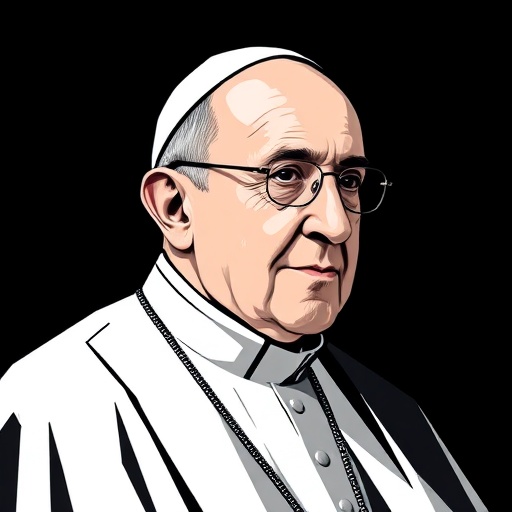
Pope Francis — "I am a sinner, I am a sinner. This is the most accurate definition. It is not a …"
I am a sinner, I am a sinner. This is the most accurate definition. It is not a figure of speech, a literary genre. I am a sinner.
I am a sinner, I am a sinner. This is the most accurate definition. It is not a figure of speech, a literary genre. I am a sinner.
Click any product to generate a realistic preview. Up to 3 at a time.
* Initial load can take up to 90 seconds — revising the preview in another color is nearly instant.
"A little bit of humor helps us to carry on."
"A Christian who is too attached to riches is an idolater."
"The roots of evil are in the heart of man."
"We must not be afraid to be a bit messy, to be a bit untidy. The Church should not be a neat and tidy thing."
"Do not be afraid of making mistakes. Do not be afraid of making noise. Do not be afraid of getting into trouble."
First Latin American and Jesuit pope (2013-), who has steered the Catholic Church toward pastoral inclusion on LGBTQ pastoral care, divorced Catholics, and climate. Closely associated with Pope John XXIII (the Vatican II reformer pope) and Cardinal Walter Kasper (his theological ally on pastoral reform). For an intellectual contrast, see Cardinal Raymond Burke, American traditionalist cardinal, former head of the Vatican Apostolic Signatura — Burke is the public face of Catholic traditionalism that views Francis's pastoral approach as doctrinally dangerous — he has formally challenged Amoris Laetitia and other Francis reforms.
Found in 1 providers: grok
1 source checked
The speaker confesses with raw honesty that they are morally flawed and imperfect — not as polite humility or poetic language, but as literal truth. By repeating it three times, they reject any interpretation as false modesty. It's a direct, unvarnished self-assessment that refuses the escape hatch of metaphor, insisting the admission be taken at face value.
Jorge Mario Bergoglio chose the papal name Francis after the humble saint of Assisi, signaling a break from institutional grandeur. As a Jesuit, he trained in rigorous self-examination. This statement echoes his famous 2013 interview answer when asked who he was — his first words were exactly this. It reflects his pastoral style: leading through acknowledged weakness rather than clerical authority.
Francis became pope in 2013 amid the Catholic Church's abuse scandals, financial corruption at the Vatican Bank, and Pope Benedict's unprecedented resignation. Institutional religious authority was under intense scrutiny globally. A pope publicly embracing personal sinfulness — not defensiveness — was a calculated counter-signal to the culture of cover-up and hierarchy that had shielded wrongdoing for decades.
AI-generated insights based on extensive research and information for context. Factual errors? Email [email protected].
Your cart is empty