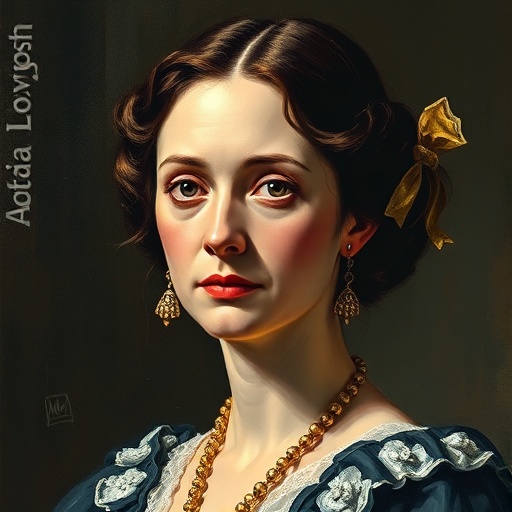
Ada Lovelace — "I am a woman of science, and I am proud of it."
I am a woman of science, and I am proud of it.
I am a woman of science, and I am proud of it.
Click any product to generate a realistic preview. Up to 3 at a time.
* Initial load can take up to 90 seconds — revising the preview in another color is nearly instant.
"The Analytical Engine is an instrument which can give results of any degree of complexity, and with any degree of accuracy."
"I am much more than a mere mathematician; I am a metaphysician."
"The Analytical Engine opens up a new era in the history of scientific investigation."
"The brain is a most wonderful machine, but it requires fuel and exercise to keep it in order."
"I shall, in due time, be a poetical scientist."
Found in 1 providers: grok
1 source checked
A declaration of identity unapologetically claiming space in a world that pressured women to stay silent. Science wasn't considered a woman's domain, yet the speaker owns both identities without apology. It expresses pride not just in achievement but in existing as a woman within a rigorous, male-dominated field. In plain terms: I belong here, I earned this, and I refuse to shrink.
Ada Lovelace was tutored in mathematics by her mother, Annabella Milbanke, specifically to counteract the supposed madness of her poet father Lord Byron. She collaborated with Charles Babbage on the Analytical Engine, writing the first algorithm in 1843. Being taken seriously as a female mathematician in Regency and Victorian England required constant self-assertion. Her scientific identity was hard-won against a culture that steered women away from rigorous intellectual work.
Lovelace lived during the early Victorian era (1815–1852), when women were barred from universities and professional scientific societies like the Royal Society. The Industrial Revolution was transforming Britain through mechanization and mathematical engineering. Charles Babbage's Analytical Engine emerged in this context, representing computation before computers existed. Women's intellectual contributions were routinely uncredited or dismissed. Claiming pride as a woman of science in 1840s England was a radical act against entrenched social and institutional exclusion.
AI-generated insights based on extensive research and information for context. Factual errors? Email [email protected].
Your cart is empty