Erwin Schrodinger — "I am no friend of probability theory, I have hated it from the first moment when…"
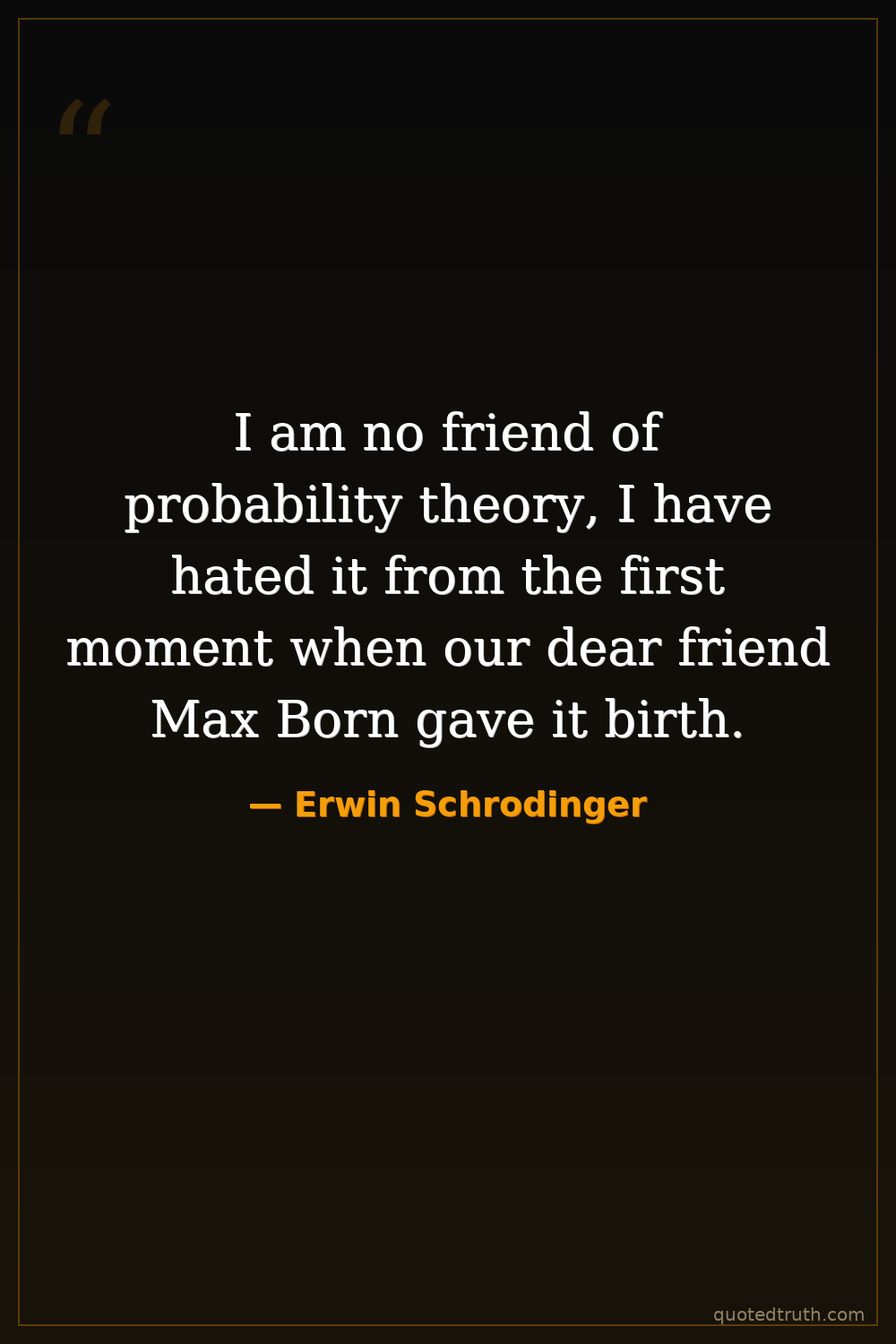
I am no friend of probability theory, I have hated it from the first moment when our dear friend Max Born gave it birth.
I am no friend of probability theory, I have hated it from the first moment when our dear friend Max Born gave it birth.
Click any product to generate a realistic preview. Up to 3 at a time.
* Initial load can take up to 90 seconds — revising the preview in another color is nearly instant.
"But the truth is that we are not living in a world of objects, but in a world of events."
"The number of degrees of freedom of the cat is enormous. Is it possible that the cat is to be described by a wave function, which is a superposition of a live and a dead cat?"
"If we were bees, ants, or Lacedaemonian warriors, to whom personal fear does not exist and cowardice is the most shameful thing in the world, warring would go on forever. But luckily we are only men —…"
"The present quantum mechanics is not a theory in the sense of the old theories, but rather a collection of rules for the calculation of probabilities."
"The world is a journey, and we are the travelers."
Austrian physicist who shared the 1933 Nobel for the wave equation that bears his name and the famous cat thought-experiment. Closely associated with Werner Heisenberg (matrix-mechanics rival who reached the same physics by different math) and Albert Einstein (his pen-pal on quantum interpretation). For an intellectual contrast, see Niels Bohr, Danish physicist and architect of the Copenhagen interpretation — Schrödinger's cat thought-experiment was specifically designed to ridicule Bohr's 'observer-dependent reality' reading of quantum mechanics — Schrödinger thought the Copenhagen interpretation was absurd; the cat was meant as reductio ad absurdum.
Expressing a strong, almost emotional, rejection of a core aspect of quantum mechanics (the probabilistic interpretation).
Date: Unknown, likely after 1926 when Born's interpretation emerged
ShockingFound in 1 providers: gemini
1 source checked
Schrödinger is rejecting the idea that quantum mechanics is fundamentally about chance. He resents the interpretation that particles only have probabilities of being in certain states until measured, rather than definite, knowable properties. He's saying he despised this probabilistic framework from the very moment Max Born proposed it, viewing it as an unwelcome surrender of physics to randomness instead of the deterministic, wave-based reality he believed described nature.
Schrödinger built wave mechanics in 1926, picturing the electron as a continuous wave with definite physical reality. When Born reinterpreted his wave function as a probability amplitude, Schrödinger felt his elegant deterministic theory had been hijacked. His famous cat thought experiment was specifically designed to mock this probabilistic view as absurd. Alongside Einstein, he remained a lifelong opponent of the Copenhagen interpretation, insisting reality must be definite, not statistical.
The 1920s–30s saw quantum theory split physicists into warring camps. Born, Bohr, and Heisenberg championed the Copenhagen interpretation, where probability was fundamental. Einstein's 'God does not play dice' captured the dissent. The Solvay Conferences became battlegrounds. Meanwhile, Nazi Germany's rise scattered these scientists across Europe and America, and the looming atomic age made these abstract debates about determinism versus chance feel urgent and consequential.
AI-generated insights based on extensive research and information for context. Factual errors? Email [email protected].
Your cart is empty