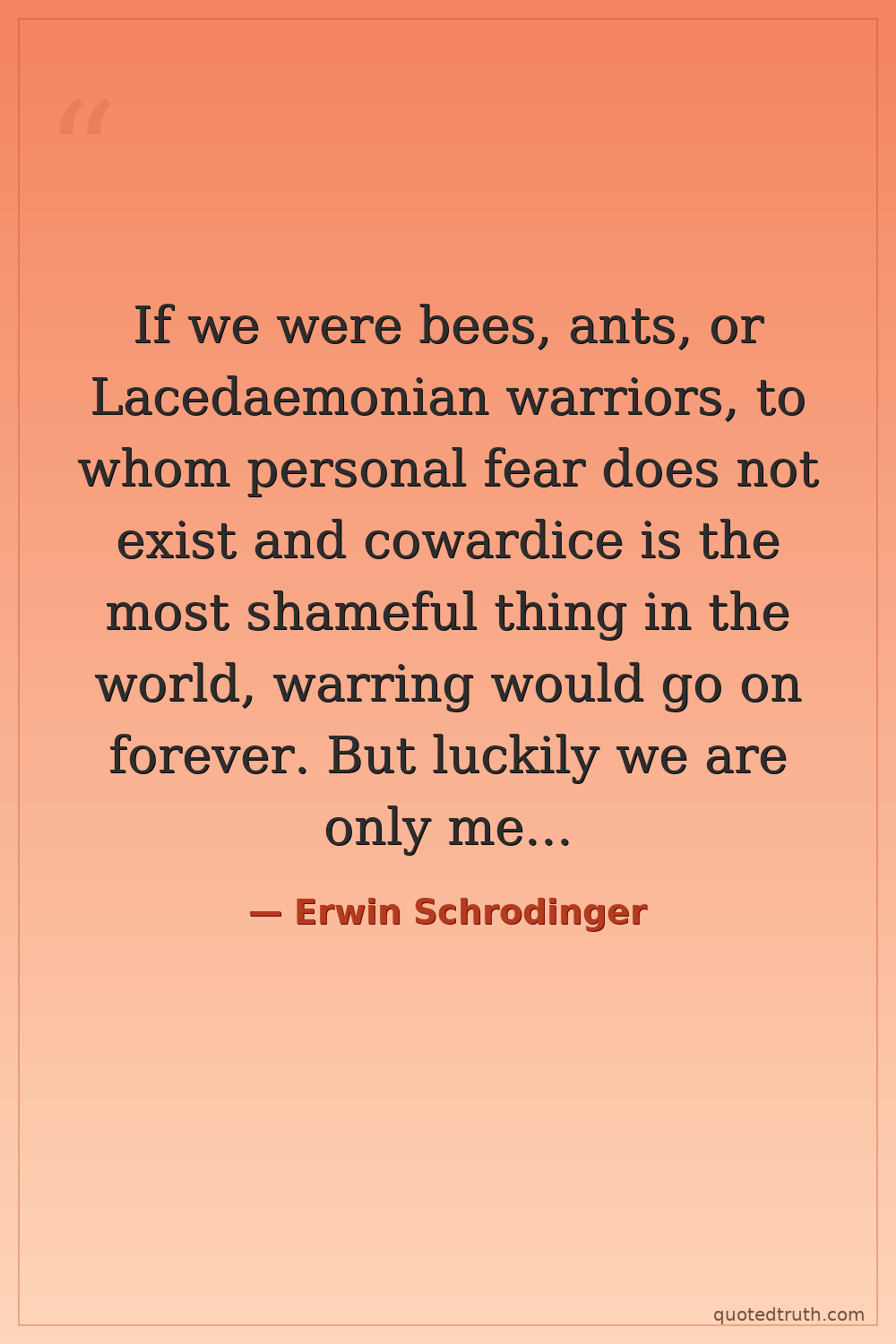
Erwin Schrodinger — "If we were bees, ants, or Lacedaemonian warriors, to whom personal fear does not…"

If we were bees, ants, or Lacedaemonian warriors, to whom personal fear does not exist and cowardice is the most shameful thing in the world, warring would go on forever. But luckily we are only men — and cowards.
Erwin Schrodinger — Erwin Schrodinger Modern · Wave mechanics

Get This Quote & Author's Image Illustrated On:

Click any product to generate a realistic preview. Up to 3 at a time.
* Initial load can take up to 90 seconds — revising the preview in another color is nearly instant.

Kitchen

Apparel

Other

About Erwin Schrodinger (1887-1961)

Austrian physicist who shared the 1933 Nobel for the wave equation that bears his name and the famous cat thought-experiment. Closely associated with Werner Heisenberg (matrix-mechanics rival who reached the same physics by different math) and Albert Einstein (his pen-pal on quantum interpretation). For an intellectual contrast, see Niels Bohr, Danish physicist and architect of the Copenhagen interpretation — Schrödinger's cat thought-experiment was specifically designed to ridicule Bohr's 'observer-dependent reality' reading of quantum mechanics — Schrödinger thought the Copenhagen interpretation was absurd; the cat was meant as reductio ad absurdum.

Details

A witty and cynical observation on human nature and conflict.

Date: Mid 20th century

General

Verification

Unverifiable

Found in 1 providers: gemini

1 source checked

Understanding this quote

What it means

Humans are fortunate to feel fear and cowardice, because these emotions act as natural brakes on endless warfare. Unlike creatures or societies driven purely by collective duty and fearlessness, ordinary people's instinct for self-preservation ultimately limits how long conflicts can sustain themselves. Our weakness, paradoxically, saves us from perpetual destruction.

Relevance to Erwin Schrodinger

Schrödinger, an Austrian physicist who lived through both World Wars, witnessed firsthand the catastrophic violence sweeping Europe. He fled Nazi Germany in 1933 due to his opposition to fascism, demonstrating personal moral courage. His scientific worldview emphasized uncertainty and complexity over rigid determinism, making him naturally skeptical of absolutist martial ideologies that demanded total sacrifice.

The era

Schrödinger lived through the most destructive wars in human history. World War I shattered European civilization, and World War II brought industrialized genocide and nuclear weapons. Totalitarian regimes glorified self-sacrifice and warrior cultures, demanding citizens suppress fear for the state. Against this backdrop, celebrating human cowardice as a civilizational safeguard was a pointed, even subversive, philosophical statement.

AI-generated insights based on extensive research and information for context. Factual errors? Email [email protected].
Your Cart

Your cart is empty