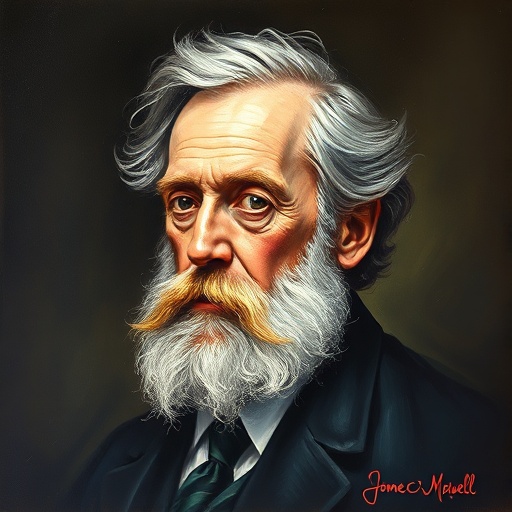
James Clerk Maxwell — "I am not a great mathematician, but I can do a little."
I am not a great mathematician, but I can do a little.
I am not a great mathematician, but I can do a little.
Click any product to generate a realistic preview. Up to 3 at a time.
* Initial load can take up to 90 seconds — revising the preview in another color is nearly instant.
"The only laws of matter are those which our minds must fabricate, and the only laws of mind are fabricated for it by matter."
"The velocity of light is a quantity of which we have now a more accurate knowledge than of any other physical constant."
"The human mind is in a state of perpetual oscillation between the actual and the possible."
"In the present state of science, it would be a rash thing to assert that any one physical constant is absolutely constant."
"It is an unscientific habit to give names to things before we know what they are."
Found in 1 providers: grok
1 source checked
The speaker downplays their mathematical ability while still acknowledging competence. It's a statement of modest confidence—admitting limits rather than claiming mastery, yet signaling enough skill to contribute meaningfully. The phrasing rejects false humility and grandiose self-promotion alike, suggesting that honest self-assessment paired with steady effort matters more than declaring oneself an expert. Small, reliable capability is worth more than inflated claims.
Maxwell unified electricity, magnetism, and light into four equations that reshaped physics, work requiring extraordinary mathematical power. Yet he was known for deep Christian humility, quiet wit, and dismissing praise. Trained at Edinburgh and Cambridge, he ranked Second Wrangler but refused to posture. Einstein later called his work the most profound shift in physics since Newton. The quote captures Maxwell's temperament: a genius who treated his gift as a modest tool rather than a platform for ego.
Maxwell lived 1831–1879, during the Victorian scientific revolution when Britain led industrial and theoretical advances. Faraday's experiments demanded mathematical formalization, and Cambridge's Mathematical Tripos forged a generation of physicists. Thermodynamics, field theory, and statistical mechanics were emerging. Scientific culture valued both rigorous proof and gentlemanly restraint, where boasting was considered vulgar. Maxwell worked alongside Kelvin, Tait, and Boltzmann as physics transitioned from mechanical intuition toward abstract mathematical description, making mathematical modesty a meaningful stance.
AI-generated insights based on extensive research and information for context. Factual errors? Email [email protected].
Your cart is empty