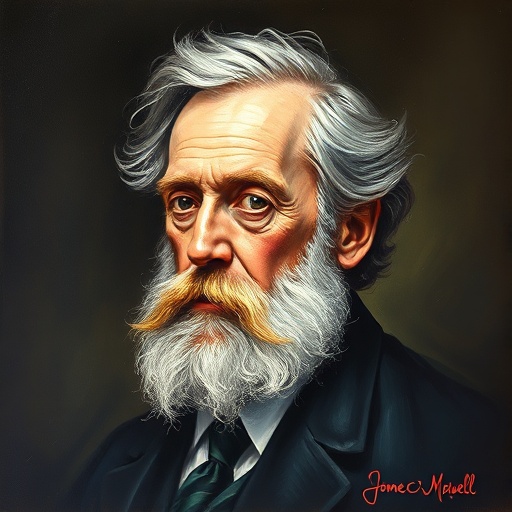
James Clerk Maxwell — "It is an unscientific habit to give names to things before we know what they are…"
It is an unscientific habit to give names to things before we know what they are.
It is an unscientific habit to give names to things before we know what they are.
Click any product to generate a realistic preview. Up to 3 at a time.
* Initial load can take up to 90 seconds — revising the preview in another color is nearly instant.
"In the very beginning of science, the parsons, who managed things then, Being handy with hammer and chisel, made gods in the likeness o' men; Till Commerce arose and at length some men of exceptional …"
"I have been trying to invent a demon who could violate the second law of thermodynamics, but he keeps getting drunk on entropy."
"Every existence above a certain rank has its singular points; the higher the rank the more of them. At these points, influences whose physical magnitude is too small to be taken account of by a finite…"
"I have been trying to think what is the difference between an experiment and an experience."
"It is a good thing to have a great many ideas, and a great many of them bad."
Found in 1 providers: grok
1 source checked
Labeling something prematurely locks in assumptions before you actually understand it. Once a name sticks, people treat it as settled and stop investigating, confusing a tidy word for real knowledge. Maxwell is warning that naming should follow careful observation and measurement, not precede it. Terminology shapes thought, so sloppy definitions breed sloppy science. First figure out what a phenomenon actually is and does, then choose language that fits the evidence.
Maxwell built his career on replacing vague concepts with rigorous mathematical definitions. He recast Faraday's intuitive 'lines of force' into precise field equations, and in thermodynamics he insisted that terms like heat, entropy, and temperature carry exact physical meaning. As a Cambridge professor and founding director of the Cavendish Laboratory, he trained students to measure first and label second. The quote captures his lifelong demand that physics speak in definitions tight enough to calculate with.
Maxwell worked in mid-Victorian Britain (1850s-1870s), when physics was shedding speculative natural philosophy for quantitative experiment. The era swarmed with half-defined terms: ether, caloric, animal magnetism, vital force. Spiritualism and pseudoscience rode alongside real discovery, and public lectures blurred the line. Meanwhile electromagnetism, thermodynamics, and kinetic theory were being born, each demanding new vocabulary. Maxwell spoke into that noise, insisting the young professional science discipline itself before glamorous names outran the evidence behind them.
AI-generated insights based on extensive research and information for context. Factual errors? Email [email protected].
Your cart is empty