Rachel Carson — "I am not a scientist in the sense that I wear a white coat and work in a laborat…"
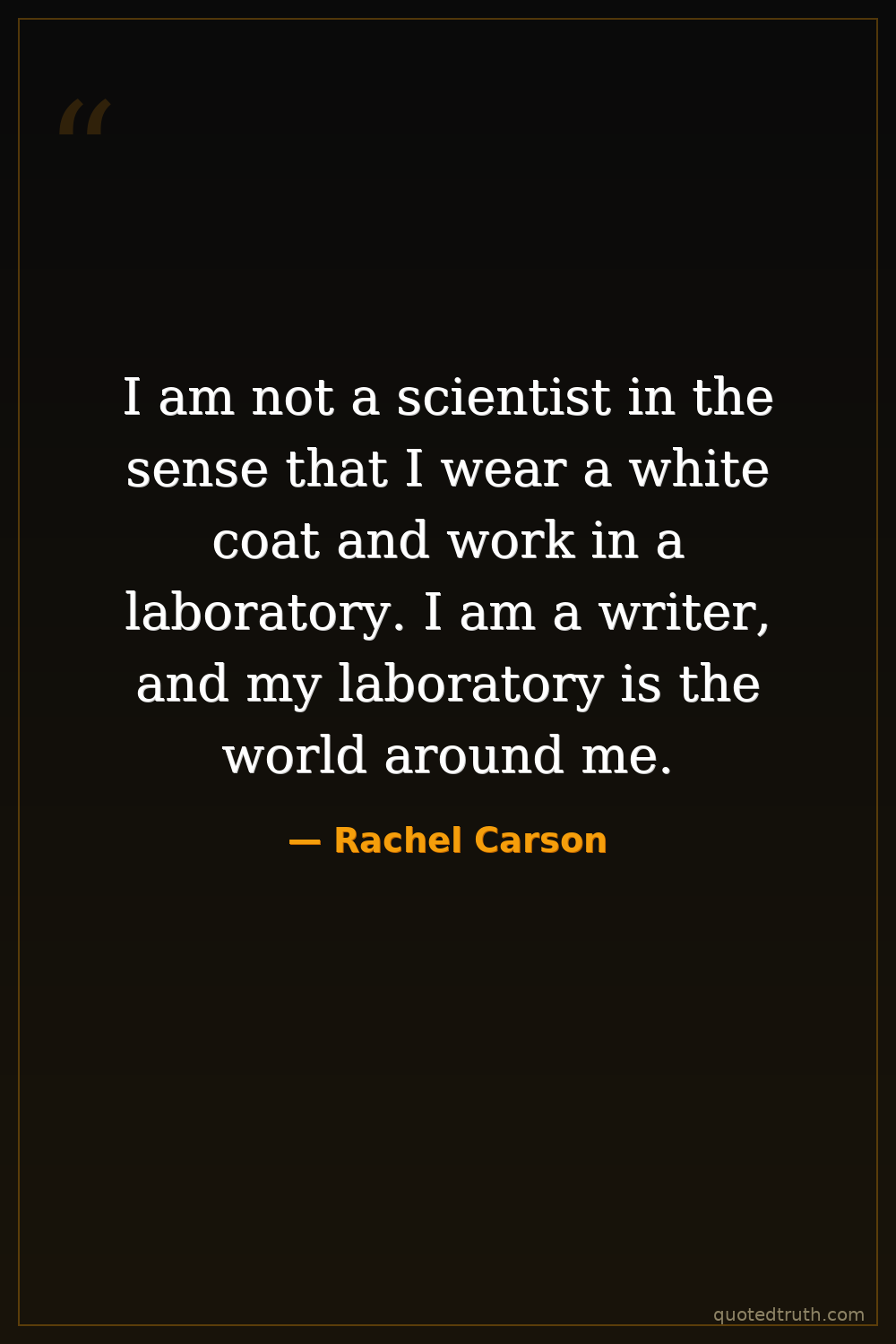
I am not a scientist in the sense that I wear a white coat and work in a laboratory. I am a writer, and my laboratory is the world around me.
I am not a scientist in the sense that I wear a white coat and work in a laboratory. I am a writer, and my laboratory is the world around me.
Click any product to generate a realistic preview. Up to 3 at a time.
* Initial load can take up to 90 seconds — revising the preview in another color is nearly instant.
"The more we learn about these chemicals, the more terrifying the prospect becomes."
"We stand now where two roads diverge. But unlike the roads in Robert Frost's familiar poem, they are not equally fair. The road we have long been traveling is deceptively easy, a smooth superhighway o…"
"Those who contemplate the beauty of the earth find reserves of strength that will endure as long as life lasts."
"The 'control of nature' is a phrase conceived in arrogance, born of the Neanderthal age of biology and the convenience of man."
"Future generations are not going to forgive us for the way we are destroying the planet."
Found in 1 providers: grok
1 source checked
Carson is pushing back against the narrow idea that science only happens in labs with controlled experiments. She sees herself as a scientist of a different kind — one whose data comes from observing the actual world: beaches, rivers, forests, ecosystems. Her 'lab' is everywhere nature exists. It's a claim that direct, careful observation of living systems is just as rigorous and valid as any controlled experiment.
Carson held a master's degree in zoology from Johns Hopkins and spent years doing field research on marine ecosystems — not lab experiments. Her books The Sea Around Us and The Edge of the Sea emerged from direct coastal observation. When Silent Spring faced industry attacks questioning her credentials, this identity — scientist-through-observation rather than laboratory technician — was her defense. Her career proved that fieldwork and writing could drive policy change as powerfully as any peer-reviewed study.
In the 1950s–60s, laboratory science enjoyed extraordinary cultural prestige — white-coated chemists had won World War II and were industrializing agriculture. DDT was a celebrated lab invention, not yet scrutinized for ecological harm. Carson's framing pushed back against this techno-optimism, asserting that field observation of actual ecosystems revealed truths no lab could replicate. The tension between controlled laboratory science and ecological observation was central to the political fight over Silent Spring's findings.
AI-generated insights based on extensive research and information for context. Factual errors? Email [email protected].
Your cart is empty