Thomas Edison — "I am not a spiritualist, but I am a firm believer in the fact that we can commun…"
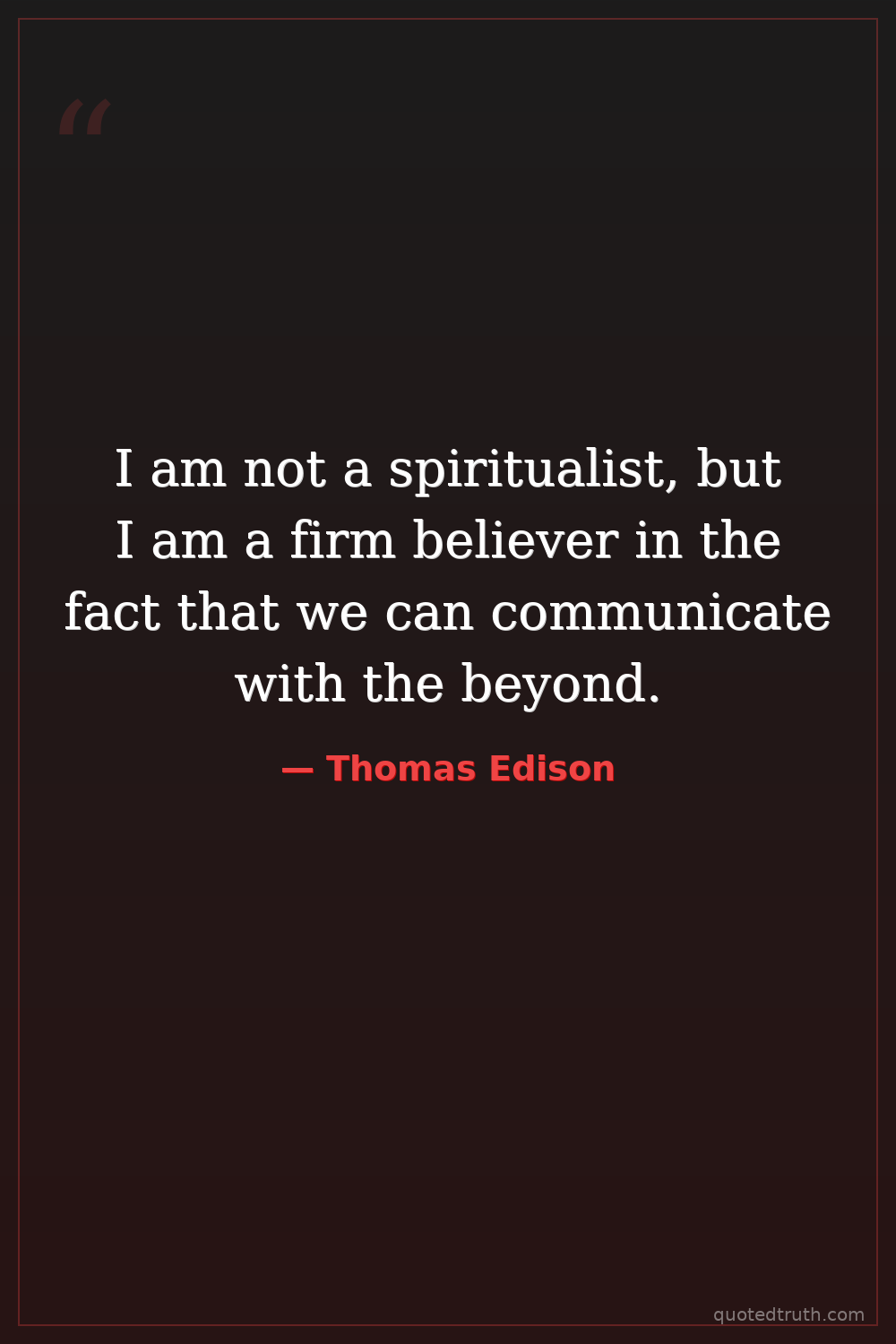
I am not a spiritualist, but I am a firm believer in the fact that we can communicate with the beyond.
I am not a spiritualist, but I am a firm believer in the fact that we can communicate with the beyond.
Click any product to generate a realistic preview. Up to 3 at a time.
* Initial load can take up to 90 seconds — revising the preview in another color is nearly instant.
"I am not a spiritualist. I am not a medium. I am a scientist. I am trying to build a machine to communicate with the dead. I am trying to prove that there is life after death. I am trying to prove tha…"
"I am not a vegetarian. I eat meat, but I don't eat much meat. I eat very little meat."
"I am not a believer in the theory of evolution. I believe in the theory of creation."
"It is not because things are difficult that we do not dare; it is because we do not dare that they are difficult."
"The chief function of the body is to carry the brain around."
Found in 1 providers: grok
1 source checked
Edison separates himself from organized spiritualism while staking a pragmatic, evidence-open position: that communication beyond death might be physically achievable rather than mystically assumed. He's not claiming religious faith — he's signaling scientific curiosity. The phrasing 'firm believer' is deliberate; he grounds conviction in reason, not ritual. This is the rationalist's hedge: reject the mystical framework wholesale, but refuse to close the door on any phenomenon before it has been empirically tested.
In 1920, Edison told Scientific American he was designing a 'spirit phone' — a sensitive instrument to detect if consciousness survives death. Not spiritualist faith, but inventor's empiricism: if personality persists after death, it must have physical properties detectable by sufficiently refined instruments. Edison was neither conventional Christian nor atheist — a deist who distrusted dogma — making this quote consistent with his lifelong insistence that every phenomenon deserves rigorous experimental investigation before dismissal.
Edison made this claim amid the great spiritualist surge of the early 1920s, when WWI and the 1918 flu pandemic left millions desperate to contact the dead. Séances and mediums flooded mainstream culture; Arthur Conan Doyle was a committed believer while Houdini debunked frauds. Simultaneously, radio had just proven invisible signals could span oceans, making detection of subtle post-death emanations seem scientifically plausible rather than purely superstitious to technically minded observers.
AI-generated insights based on extensive research and information for context. Factual errors? Email [email protected].
Your cart is empty