What it means
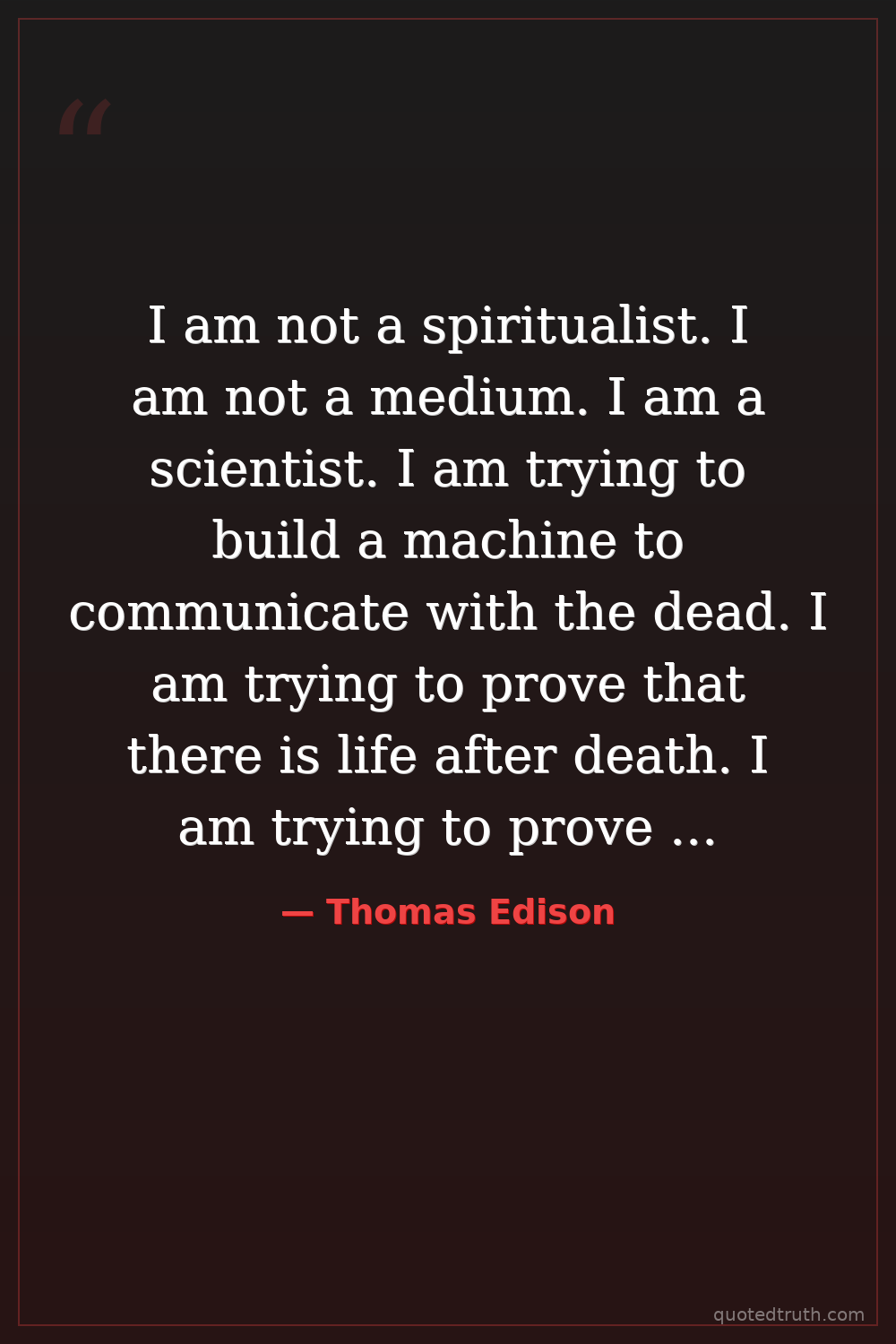
Edison declares his approach to the afterlife is scientific, not mystical. He rejects being labeled a spiritualist or medium, insisting he's an inventor attempting to engineer a device that could detect or communicate with the deceased. His goal is empirical proof that consciousness survives death and that the soul persists, treating immortality as a testable hypothesis rather than a matter of faith or religious belief.
Relevance to Thomas Edison
Edison, the methodical inventor behind the phonograph and incandescent bulb, genuinely pursued a 'spirit phone' in the 1920s, discussing it in a 1920 American Magazine interview. Despite his reputation as a hard empiricist who dismissed superstition, he believed consciousness consisted of 'life units' that might persist and be detectable with sensitive instruments. The quote captures his signature conviction: any phenomenon, even the afterlife, could yield to the right apparatus and enough tinkering.
The era
The 1920s saw a spiritualism boom following World War I's mass casualties and the 1918 flu pandemic, with grieving families flocking to mediums and seances. Arthur Conan Doyle championed the movement while Houdini debunked frauds. Simultaneously, radio, X-rays, and electromagnetism were revealing invisible realities, making 'scientific' contact with the dead seem plausible. Edison's statement reflects an era where technology's rapid advance blurred the line between physics and metaphysics in public imagination.
AI-generated insights based on extensive research and information for context. Factual errors? Email [email protected].