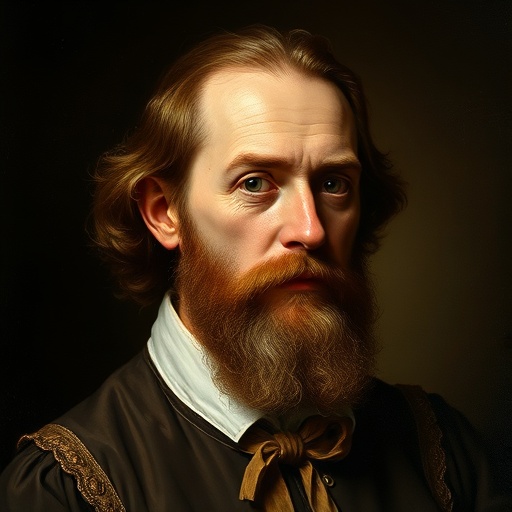
William Harvey — "I am not so mad, nor have I been so caught up in the opinion of others, as to be…"

I am not so mad, nor have I been so caught up in the opinion of others, as to believe that I have discovered anything so great as to be worthy of the name of a new opinion.
William Harvey — William Harvey Early Modern · Blood circulation

Get This Quote & Author's Image Illustrated On:

Click any product to generate a realistic preview. Up to 3 at a time.
* Initial load can take up to 90 seconds — revising the preview in another color is nearly instant.

Kitchen

Apparel

Other

About William Harvey (1578-1657)

English physician whose On the Motion of the Heart and Blood in Animals (1628) demonstrated blood circulation, overturning 1,400 years of Galenic medicine. Closely associated with Francis Bacon (his contemporary in the new English empiricism). For an intellectual contrast, see Galenic medicine, the 2nd-century Greek medical tradition (humors, blood-as-consumed-fuel) — Harvey calculated that the heart pumps more blood per hour than the body could possibly produce as fuel — a single quantitative observation that demolished the entire Galenic-Aristotelian medical worldview. The cleanest example in medical history of arithmetic disproving 14 centuries of authority.

Details

De Motu Cordis, Chapter 17 (A humble disclaimer in his revolutionary work)

Date: 1628

Educational

Verification

Unverifiable

Found in 1 providers: grok

1 source checked

Understanding this quote

What it means

Harvey is expressing deliberate humility about his own discoveries, stating he does not consider himself so arrogant or opinion-hungry as to claim he has uncovered something revolutionary. He frames his work as careful observation rather than ego-driven novelty-seeking, emphasizing that truth-telling, not fame or recognition, drives his scientific inquiry.

Relevance to William Harvey

Harvey spent decades methodically demonstrating blood circulates continuously through the heart and vessels, overturning Galen's 1,400-year-old model. His humility here reflects his actual method: painstaking dissection and vivisection across dozens of species before publishing De Motu Cordis in 1628. He faced fierce opposition from established physicians and deliberately downplayed revolutionary implications to survive professional backlash.

The era

In early 17th-century Europe, challenging Galenic medicine was professionally and sometimes personally dangerous. Ancient authorities held near-sacred status in universities. Harvey published during the Scientific Revolution when Galileo faced the Inquisition and natural philosophers carefully framed discoveries to avoid accusations of arrogance or heresy. Claiming a 'new opinion' invited ridicule and career destruction, making strategic humility essential for acceptance.

AI-generated insights based on extensive research and information for context. Factual errors? Email [email protected].
Your Cart

Your cart is empty