William Harvey — "I have not only affirmed, but also demonstrated, the circulation of the blood."
I have not only affirmed, but also demonstrated, the circulation of the blood.
I have not only affirmed, but also demonstrated, the circulation of the blood.
Click any product to generate a realistic preview. Up to 3 at a time.
* Initial load can take up to 90 seconds — revising the preview in another color is nearly instant.
"It is by experiment alone that we can arrive at the knowledge of nature."
"The world is full of wonders, but man is the greatest wonder of all."
"The blood flows from the right ventricle through the lungs to the left auricle."
"The circulation of the blood is a new doctrine, and I doubt not but it will meet with its opponents."
"The truth is always simple, but the way to it is complex."
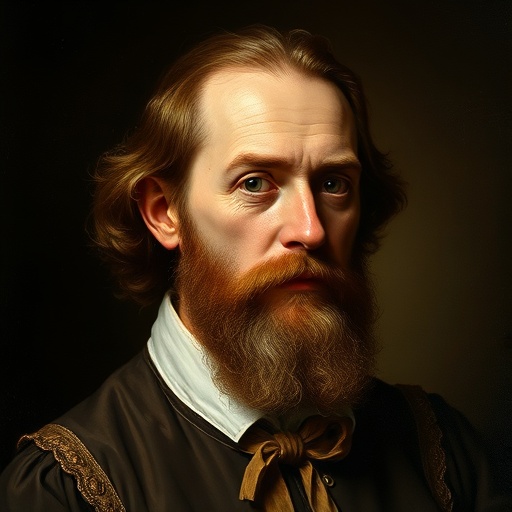
English physician whose On the Motion of the Heart and Blood in Animals (1628) demonstrated blood circulation, overturning 1,400 years of Galenic medicine. Closely associated with Francis Bacon (his contemporary in the new English empiricism). For an intellectual contrast, see Galenic medicine, the 2nd-century Greek medical tradition (humors, blood-as-consumed-fuel) — Harvey calculated that the heart pumps more blood per hour than the body could possibly produce as fuel — a single quantitative observation that demolished the entire Galenic-Aristotelian medical worldview. The cleanest example in medical history of arithmetic disproving 14 centuries of authority.
Found in 1 providers: grok
1 source checked
Harvey is asserting that he didn't merely claim blood circulates through the body — he proved it through systematic observation and experiment. The distinction between assertion and demonstration is deliberate: he is staking his reputation on reproducible evidence, not authority or tradition. This is a declaration that empirical proof, not inherited wisdom, is the foundation of his medical truth.
Harvey spent decades conducting dissections and animal experiments to map how the heart pumps blood in a continuous loop. His 1628 work De Motu Cordis challenged Galenic medicine that had dominated for 1,400 years. This quote captures his core identity: a physician who trusted his own hands and eyes over ancient texts, willing to endure ridicule to defend what he had physically demonstrated.
In the early 17th century, Galenic humoral theory was medical orthodoxy enforced by universities and the Church. Challenging it risked professional ruin. The Scientific Revolution was stirring — Galileo, Bacon, and Vesalius had begun privileging observation over authority. Harvey's insistence on demonstration over assertion placed him squarely in this emerging empiricist tradition, making his claim politically and intellectually radical, not merely academic.
AI-generated insights based on extensive research and information for context. Factual errors? Email [email protected].
Your cart is empty