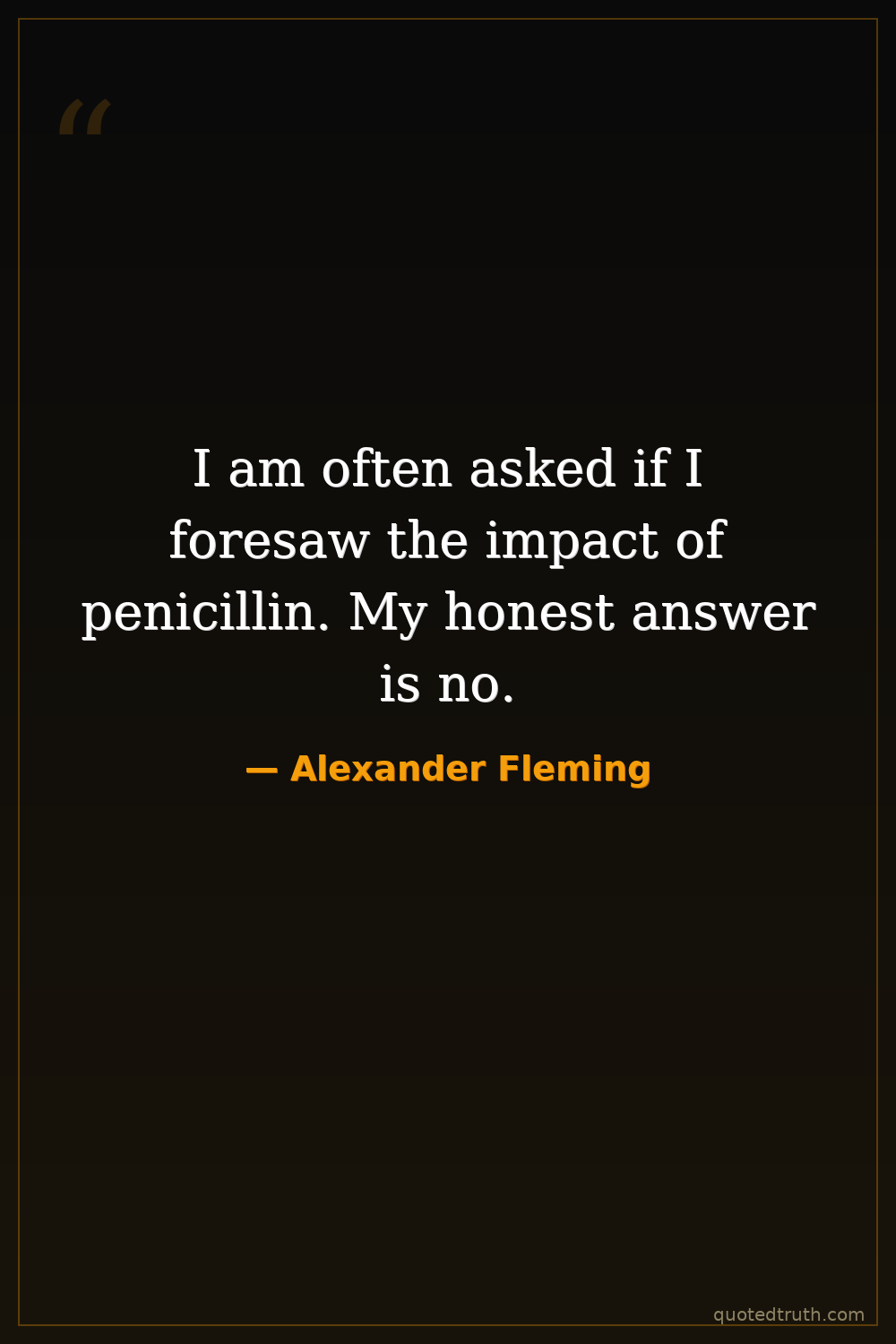
Alexander Fleming — "I am often asked if I foresaw the impact of penicillin. My honest answer is no."
I am often asked if I foresaw the impact of penicillin. My honest answer is no.
I am often asked if I foresaw the impact of penicillin. My honest answer is no.
Click any product to generate a realistic preview. Up to 3 at a time.
* Initial load can take up to 90 seconds — revising the preview in another color is nearly instant.
"The story of penicillin has a certain romantic appeal, and I think that may be one of the reasons it has attracted so much attention. But the real story is much more prosaic."
"It is the common lot of discoverers to be misunderstood."
"I had no idea at the time that I was making a discovery that would change the course of medicine."
"The discovery of penicillin was a series of lucky accidents."
"The greatest discovery of my life was not penicillin, but the fact that I was wrong about something."
Found in 1 providers: grok
1 source checked
Fleming admits he had no idea how profoundly penicillin would change medicine and human history. The quote captures a fundamental truth about discovery: the person who finds something transformative often can't see its full significance in the moment. It's a candid acknowledgment that scientific breakthroughs don't come with impact forecasts — the world reveals their meaning over time, not at the instant of discovery.
Fleming's 1928 discovery was itself accidental — a contaminated petri dish, a mold killing nearby bacteria. He published findings but didn't develop penicillin into a drug; Howard Florey and Ernst Chain did that in the 1940s. Fleming consistently credited luck and observation over genius. This quote reflects his lifelong candor and self-deprecating character — a man who won the Nobel Prize yet never overstated his own foresight or intent.
Fleming lived through an era when bacterial infections — strep, pneumonia, infected wounds — were frequently fatal. World War I demonstrated how infection killed more soldiers than combat in many campaigns. Penicillin's mass production during World War II transformed medicine virtually overnight, saving hundreds of thousands of lives. The scale of that shift, from helplessness before bacteria to reliable treatment, makes his admission of not foreseeing it all the more striking.
AI-generated insights based on extensive research and information for context. Factual errors? Email [email protected].
Your cart is empty