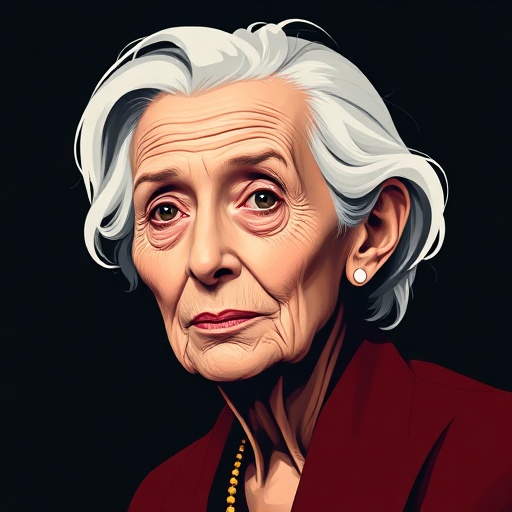
Jane Goodall — "I believe that every single one of us can make a difference."
I believe that every single one of us can make a difference.
I believe that every single one of us can make a difference.
Click any product to generate a realistic preview. Up to 3 at a time.
* Initial load can take up to 90 seconds — revising the preview in another color is nearly instant.
"My life's work has been to try and help people understand that animals are not just things."
"We have to realize that we are all interconnected, and that our actions have consequences."
"The future of the planet depends on us, and we need to take that responsibility seriously."
"We need to teach our children to respect nature."
"We need to teach our children to be good stewards of the Earth, and to protect its resources."
British primatologist who in 1960 began the longest-running wild primate study at Gombe Stream, transforming our understanding of chimpanzees. Closely associated with Dian Fossey (mountain-gorilla researcher) and Birutė Galdikas (orangutan researcher; together with Goodall and Fossey one of Louis Leakey's 'Trimates'). For an intellectual contrast, see Walter Palmer, American dentist who killed Cecil the Lion in Zimbabwe in 2015 — Palmer represents the trophy-hunting tradition Goodall's life's work has been organized against — the colonial-era hunter-naturalist worldview that treated primates and big game as specimens or trophies, which Goodall's Roots & Shoots and Jane Goodall Institute exist specifically to displace.
Found in 1 providers: grok
1 source checked
Individual action carries real power—change doesn't require institutional authority or vast resources. Anyone, regardless of status or background, can shift outcomes through their choices and daily behavior. This is a direct rejection of helplessness in the face of large-scale problems like extinction, environmental destruction, or social injustice. It frames personal agency not as naïve optimism but as a functional operating principle for tackling problems that feel too large to solve.
Goodall embodied this belief personally—a young woman with no formal degree who became the world's foremost chimpanzee expert by simply going to Gombe in 1960 and staying. She later founded the Roots & Shoots youth program precisely to operationalize this belief, training hundreds of thousands of young people globally. Her entire post-research career became a demonstration that one determined individual, through sustained effort, reshapes scientific understanding and conservation policy.
Goodall's public voice grew through an era of accelerating ecological loss: the 1980s rainforest crisis, the 1992 Rio Earth Summit, rising extinction rates through the 1990s and 2000s, and growing climate paralysis. Mass environmental despair—the sense that problems were too systemic for individuals to address—was widespread. Her message pushed directly against that fatalism, arriving when conservation movements urgently needed to mobilize ordinary people rather than wait for governmental or corporate action.
AI-generated insights based on extensive research and information for context. Factual errors? Email [email protected].
Your cart is empty