Nicolaus Copernicus — "I confess that I have been led to conceive of a different arrangement of the sph…"
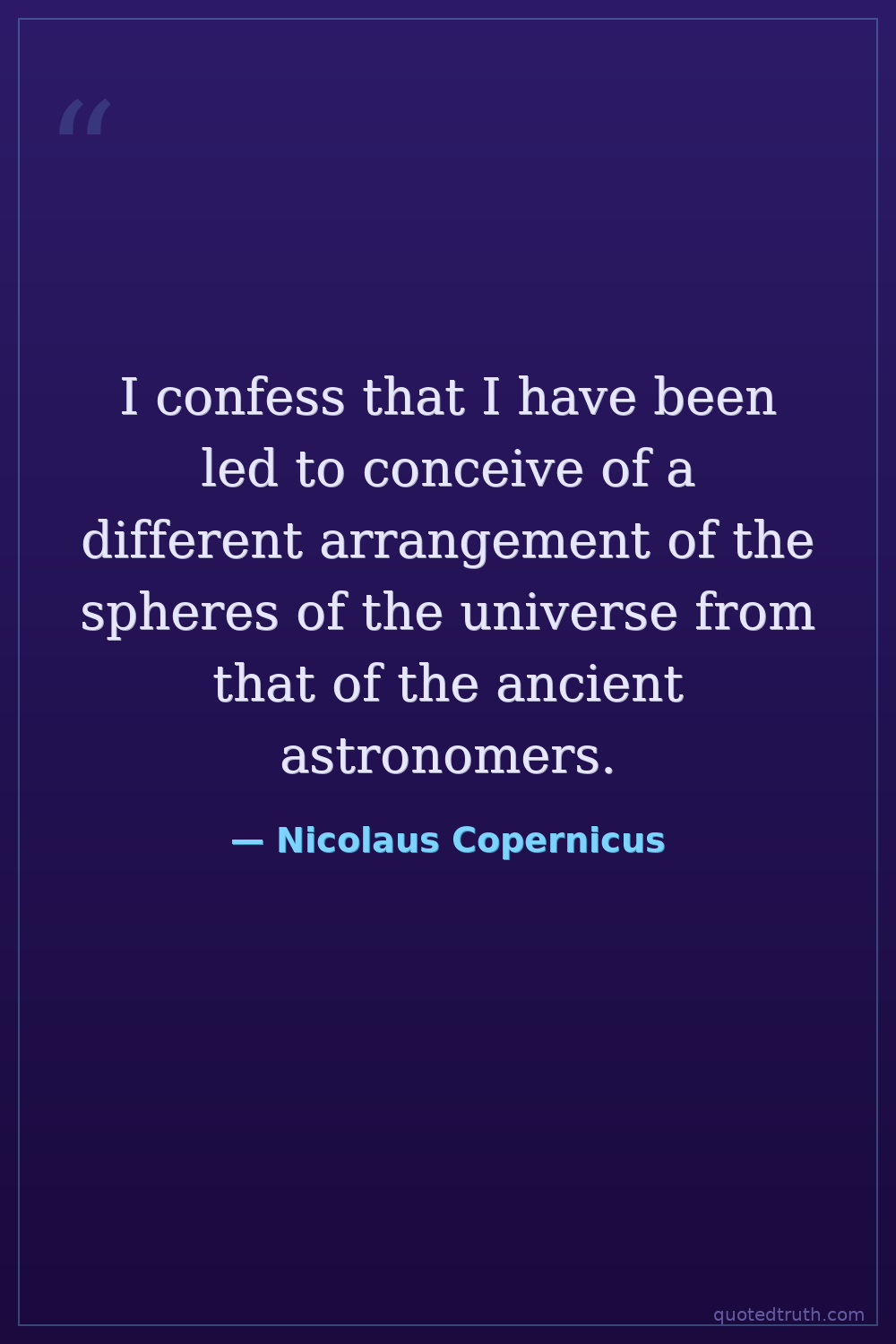
I confess that I have been led to conceive of a different arrangement of the spheres of the universe from that of the ancient astronomers.
I confess that I have been led to conceive of a different arrangement of the spheres of the universe from that of the ancient astronomers.
Click any product to generate a realistic preview. Up to 3 at a time.
* Initial load can take up to 90 seconds — revising the preview in another color is nearly instant.
"The world is not a machine, but a living body, with a soul and a mind."
"For it is the duty of an astronomer to gather by careful and skilled observation the history of the celestial movements, and then to investigate their causes or hypotheses about them, and then to pred…"
"To know the mighty works of God, to comprehend His wisdom and majesty and power; to appreciate, in degree, the wonderful workings of His laws, surely all this must be a pleasing and acceptable mode of…"
"To know that we know what we know, and to know that we do not know what we do not know, that is true knowledge."
"It is clear that the earth also moves in a similar manner, and describes an annual course."
Found in 1 providers: grok
1 source checked
Copernicus is openly admitting he has developed a fundamentally different theory of how the cosmos is structured compared to what astronomers had accepted for over a thousand years. He is not boasting—the word 'confess' signals humility and awareness of controversy. In plain terms: he concluded the ancient model was wrong and worked out a better one, even knowing this claim would challenge beliefs held as sacred and settled truth.
Copernicus spent over thirty years quietly developing his heliocentric model before publishing De revolutionibus in 1543, the year he died. As a church canon in Poland, he understood the theological stakes of displacing Earth from the center of creation. The confessional tone reflects his cautious character. His dual identity as clergyman and astronomer made this intellectual break acutely personal—he was effectively dissenting from institutions he served and respected his entire life.
In the early sixteenth century, Ptolemy's Earth-centered cosmos had dominated European thought for 1,400 years, endorsed by the Catholic Church as scripturally consistent. The Renaissance was reviving classical scholarship while the Reformation fractured religious authority. Copernicus wrote when challenging Church doctrine carried genuine danger—his book was eventually banned in 1616. His deferential phrasing reflects the collision between emerging empirical inquiry and an institution that still controlled the boundaries of permissible knowledge.
AI-generated insights based on extensive research and information for context. Factual errors? Email [email protected].
Your cart is empty