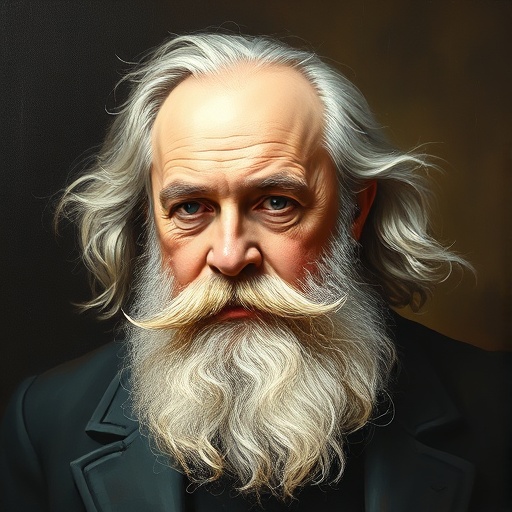
Dmitri Mendeleev — "I consider it my duty to warn against this tendency to make a science of alchemy…"
I consider it my duty to warn against this tendency to make a science of alchemy.
I consider it my duty to warn against this tendency to make a science of alchemy.
Click any product to generate a realistic preview. Up to 3 at a time.
* Initial load can take up to 90 seconds — revising the preview in another color is nearly instant.
"It was clear that in the United States there was a development not of the best, but of the middle and worst sides of European civilization; the notorious general voting, the tendency to politics... al…"
"I have achieved neither fame nor wealth, but I have learned to know the human heart."
"The structure of the elements is a matter of the internal structure of their atoms."
"It is the function of science to discover the existence of a general reign of order in nature and to find the causes governing this order. And this refers in equal measure to the relations of man - so…"
"The universe is a vast chemical laboratory."
Criticizing pseudo-science, particularly in relation to spiritualism
Date: Late 19th century
EducationalFound in 1 providers: grok
1 source checked
Mendeleev is cautioning people against dressing up pseudoscience in scientific clothing. He draws a sharp line between rigorous, testable chemistry and the mystical, secretive practices of alchemy. Calling something a science does not make it one; genuine science demands evidence, reproducibility, and systematic reasoning. He feels personally responsible to speak up when he sees mysticism or speculation being marketed as legitimate scientific inquiry, because confusing the two corrupts public understanding and slows real progress.
Mendeleev built the periodic table by insisting on measurable atomic weights, reproducible experiments, and predictive rigor, famously forecasting undiscovered elements like gallium and germanium from empirical patterns. A devout empiricist, he openly attacked spiritualism and seances popular among Russian intellectuals, even serving on a commission to debunk mediums. Treating alchemy as science offended his lifelong conviction that chemistry must be grounded in data, not mysticism, making this warning consistent with his public crusades.
Mendeleev lived 1834-1907, when chemistry was maturing into a disciplined science and shedding alchemical roots, yet Victorian spiritualism, theosophy, and occult revivals were surging across Europe and Russia. Wealthy patrons funded mediums, and some scientists flirted with mystical explanations for newly discovered phenomena like radioactivity and electromagnetism. Russia's intelligentsia debated reason versus mysticism intensely. Mendeleev wrote and spoke publicly during this clash, defending experimental method against fashionable pseudoscience that threatened to blur hard-won boundaries between evidence and superstition.
AI-generated insights based on extensive research and information for context. Factual errors? Email [email protected].
Your cart is empty