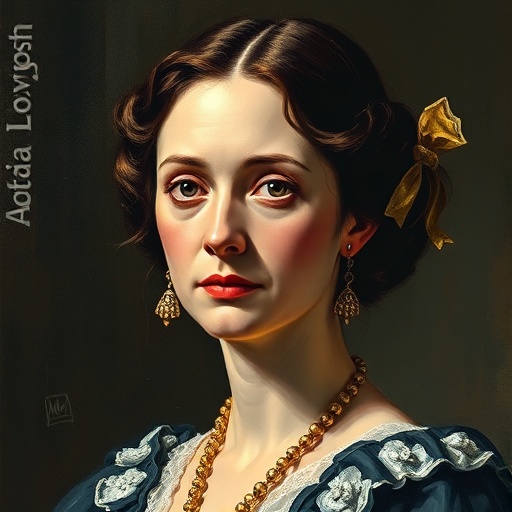
Ada Lovelace — "I consider myself a high priestess of science."
I consider myself a high priestess of science.
I consider myself a high priestess of science.
Click any product to generate a realistic preview. Up to 3 at a time.
* Initial load can take up to 90 seconds — revising the preview in another color is nearly instant.
"I am most anxious to get the work done well, and to make it a first-rate thing."
"I am a firm believer in the importance of accuracy in all things."
"I believe that science and art are intimately connected, and that both are essential for human progress."
"I am a creature of logic and reason, but also of imagination and intuition."
"The Analytical Engine has no pretensions whatever to originate anything. It can do whatever we know how to order it to perform."
Found in 1 providers: grok
1 source checked
Someone who sees themselves as a devoted authority figure of science — the way a high priestess is both leader and servant of sacred practices. The speaker claims science as something worthy of reverence and total dedication, positioning themselves not as a casual student but as someone who has consecrated their life to it. The title implies deep knowledge alongside a spiritual calling toward intellectual discovery, making expertise feel like a vocation rather than merely a profession.
Ada Lovelace worked in a world that barred women from universities and scientific societies, yet she collaborated with Charles Babbage on his Analytical Engine and wrote the first machine algorithm in the 1840s. She described her own approach as "poetical science," deliberately fusing imagination with mathematical rigor. Her self-designation as "high priestess" reflects her fierce self-belief and refusal to accept the decorative, peripheral role Victorian society assigned to intellectual women.
In early Victorian Britain, science was undergoing explosive growth — Darwin was developing evolutionary theory, Babbage was building mechanical computers, and industrialization was reshaping civilization. Yet institutions like the Royal Society excluded women entirely from membership. Religion still dominated public life, making Lovelace's "priestess" framing culturally charged — she was simultaneously claiming sacred authority for science and inserting a woman into a leadership role society reserved exclusively for men.
AI-generated insights based on extensive research and information for context. Factual errors? Email [email protected].
Your cart is empty