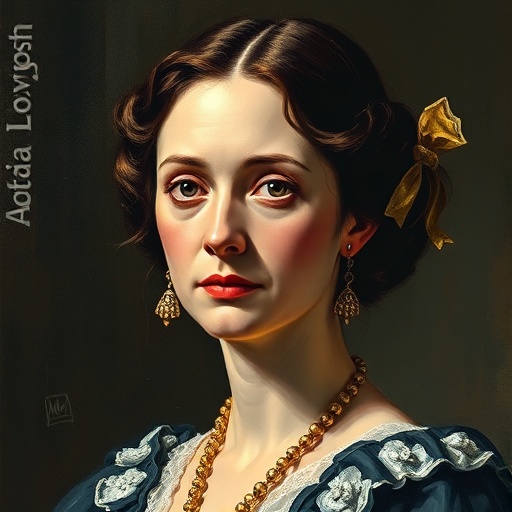
Ada Lovelace — "I consider myself a kind of scientific explorer, venturing into uncharted territ…"
I consider myself a kind of scientific explorer, venturing into uncharted territory.
I consider myself a kind of scientific explorer, venturing into uncharted territory.
Click any product to generate a realistic preview. Up to 3 at a time.
* Initial load can take up to 90 seconds — revising the preview in another color is nearly instant.
"I have a peculiar way of looking at things, which is sometimes a disadvantage, but sometimes a great advantage."
"I am driven by a desire to understand the fundamental laws of the universe."
"My brain is a queer piece of mechanism."
"The Analytical Engine is not merely a calculating machine. It is a thinking machine."
"I am most anxious to get the work done well, and to make it a first-rate thing."
Found in 1 providers: grok
1 source checked
Someone who calls themselves a 'scientific explorer venturing into uncharted territory' claims the identity of a pioneer rather than a practitioner. They are not refining what exists — they are creating categories. This framing rejects expert caution in favor of curiosity-led movement into the genuinely unknown, where failure is expected and precedent is absent. It is an assertion of agency in the face of total uncertainty.
Ada Lovelace collaborated with Charles Babbage on the Analytical Engine — a computing machine that never achieved working form in her lifetime. She authored the first published algorithm designed for a machine, extensively annotating Luigi Menabrea's paper with notes that exceeded the original text. As a woman doing rigorous mathematical work in the 1840s, she had no predecessors to follow, making her self-description as an explorer precisely accurate.
The 1840s predated professional computer science by over a century. Babbage's Analytical Engine was purely theoretical; no working general-purpose computer existed. Women were largely excluded from formal scientific institutions and rarely credited for intellectual contributions. Mathematics was shifting from pure abstraction toward applied computation. Lovelace's vision that machines could process symbols, music, and language beyond raw numbers was so radical it went unrecognized until the mid-twentieth century.
AI-generated insights based on extensive research and information for context. Factual errors? Email [email protected].
Your cart is empty