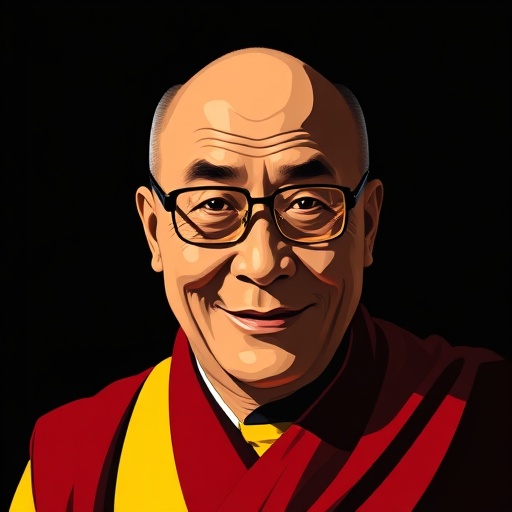
Dalai Lama (14th) — "I consider myself a simple Buddhist monk. My life is not complicated."
I consider myself a simple Buddhist monk. My life is not complicated.
I consider myself a simple Buddhist monk. My life is not complicated.
Click any product to generate a realistic preview. Up to 3 at a time.
* Initial load can take up to 90 seconds — revising the preview in another color is nearly instant.
"My main interest is to make people happy. If they are happy, I am happy."
"The Chinese people are very good people."
"I think the world needs more laughter. Laughter is the best medicine."
"In the practice of tolerance, one’s enemy is the best teacher."
"Sometimes one creates a dynamic impression by saying something, and sometimes one creates as significant an impression by remaining silent."
Found in 1 providers: grok
1 source checked
Despite being one of the world's most recognized spiritual and political figures, the Dalai Lama deliberately declines to identify with celebrity, authority, or complexity. He roots his self-understanding in the most fundamental Buddhist role: a monk who meditates and practices compassion daily. His core principles—non-attachment, impermanence, kindness toward all beings—aren't complicated philosophies but lived habits that require no status or power to maintain.
Tenzin Gyatso was identified as the 14th Dalai Lama at age two, forced into exile in 1959 after China's annexation of Tibet, and has lived as a refugee monk in Dharamsala, India ever since. Despite winning the Nobel Peace Prize, meeting world leaders, and authoring dozens of books, he wakes at 3:30 AM daily for hours of meditation. His consistent self-description as just a monk reflects a lifelong commitment to Buddhist non-attachment over ego.
The contemporary era elevated spiritual teachers into global celebrities and brands—self-help gurus and televangelists amassed wealth while framing spirituality as product. Meanwhile, China's annexation of Tibet transformed the Dalai Lama into an unavoidable geopolitical symbol. His insistence on simple monk identity pushed back against both forces: the commodification of spiritual leadership and the political weight projected onto him by governments, activists, and millions of followers worldwide.
AI-generated insights based on extensive research and information for context. Factual errors? Email [email protected].
Your cart is empty