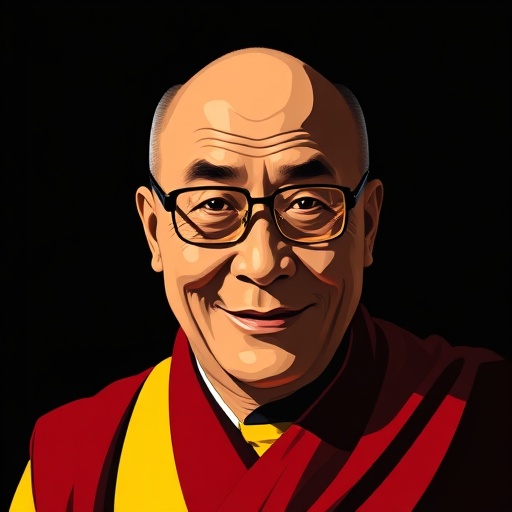
Dalai Lama (14th) — "In the practice of tolerance, one’s enemy is the best teacher."
In the practice of tolerance, one’s enemy is the best teacher.
In the practice of tolerance, one’s enemy is the best teacher.
Click any product to generate a realistic preview. Up to 3 at a time.
* Initial load can take up to 90 seconds — revising the preview in another color is nearly instant.
"I think the modern world is too much focused on material things. We need to focus more on spiritual values."
"I remain convinced that the basic human nature is gentle and compassionate."
"I believe that all human beings are fundamentally good. Sometimes they just get confused."
"Choose to be optimistic, it feels better."
"Compassion is the radicalism of our time."
Found in 1 providers: deepseek
1 source checked
Real tolerance isn't tested by people who agree with you or treat you kindly — those interactions require no effort. The people who hurt you, oppose you, or wish you harm are the ones who actually force you to practice restraint, empathy, and compassion. Without that friction, tolerance stays theoretical. Growth in this quality can only happen when it costs something, and that cost comes from adversaries, not allies.
Tenzin Gyatso has practiced this philosophy against the hardest possible opponent: the Chinese government, which seized Tibet in 1950 and forced him into exile in 1959, where he has remained for over six decades. Rather than advocate revenge or hatred, he consistently frames China's leaders as teachers who strengthen his practice of compassion. His Nobel Peace Prize in 1989 recognized precisely this commitment — meeting occupation with forgiveness rather than enmity.
This quote emerged during an era defined by Cold War ideological warfare, decolonization conflicts, and the brutal suppression of ethnic and religious minorities worldwide. Tibet itself became a symbol of cultural genocide under Maoist China's Cultural Revolution, which destroyed thousands of monasteries. In a century that repeatedly answered violence with violence — from WWII through nuclear brinkmanship — a spiritual leader preaching that enemies deserve gratitude rather than retaliation represented a genuinely countercultural stance.
AI-generated insights based on extensive research and information for context. Factual errors? Email [email protected].
Your cart is empty