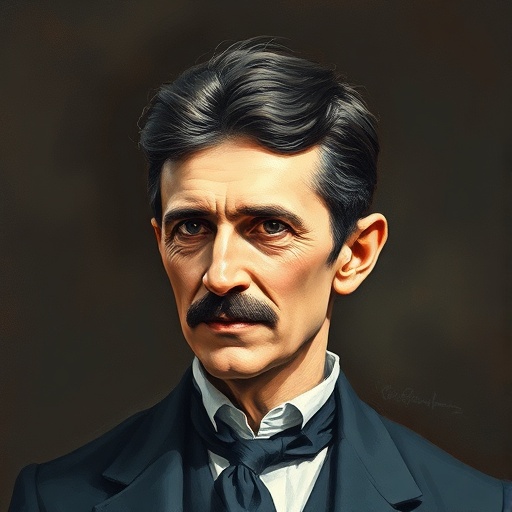
Nikola Tesla — "I consider myself a very fortunate man, because I have been able to devote my en…"
I consider myself a very fortunate man, because I have been able to devote my entire life to the pursuit of knowledge and the service of humanity.
I consider myself a very fortunate man, because I have been able to devote my entire life to the pursuit of knowledge and the service of humanity.
Click any product to generate a realistic preview. Up to 3 at a time.
* Initial load can take up to 90 seconds — revising the preview in another color is nearly instant.
"If the genius of invention were to reveal to-morrow the secret of immortality, of eternal beauty and youth, for which all humanity is aching, the same inexorable agents which prevent a mass from chang…"
"As I review the events of my past life I realize how subtle are the influences that shape our destinies."
"There are three possible solutions to the problem of increase of human energy: nutrition, peace, work."
"The scientists of today think deeply instead of clearly. One must be sane to think clearly, but one can think deeply and be quite insane."
"My brain is only a receiver, in the Universe there is a core from which we obtain knowledge, strength and inspiration. I have not penetrated into the secrets of this core, but I know that it exists."
Serbian-American inventor and electrical engineer whose alternating-current designs powered the modern electrical grid; died poor and largely forgotten. Closely associated with George Westinghouse (his AC-power business partner) and Mihajlo Pupin (fellow Serbian-American physicist at Columbia). For an intellectual contrast, see Thomas Edison, American inventor and direct-current advocate — Edison's direct-current power-distribution scheme was displaced by Tesla-Westinghouse AC in the 1890s 'War of Currents'. Edison ran a public-relations campaign electrocuting animals to discredit AC — the most famous engineering-ethics rivalry in American history. Tesla's AC won and powers nearly every electrical grid on Earth.
While reflecting his general sentiment, this specific wording is a common paraphrase rather than a direct, verifiable quote.
Date: Unknown
GeneralFound in 1 providers: grok
1 source checked
The speaker counts themselves lucky for spending their whole life doing meaningful work, combining personal passion with contribution to others. True fortune, they suggest, isn't wealth or fame but alignment between what you love doing and what actually helps people. A life spent in purposeful pursuit of understanding is the highest form of luck a person can experience.
Tesla spent decades pioneering alternating current, the radio, and wireless energy transmission, often sacrificing financial security and credit for his work. He died nearly penniless in a New York hotel room, yet expressed no regret. This quote captures his genuine belief that scientific discovery was its own reward, more valuable than the patents and profits Edison and Westinghouse accumulated.
Tesla worked during the Second Industrial Revolution, when electricity was reshaping civilization and inventors competed fiercely for patents and commercial dominance. The late 1800s through early 1900s saw rapid mechanization, urbanization, and the birth of modern corporations. Against this backdrop of commercialism, Tesla's framing of his work as humanitarian service rather than business stood in deliberate contrast to the era's dominant profit-driven ethos.
AI-generated insights based on extensive research and information for context. Factual errors? Email [email protected].
Your cart is empty