Isaac Newton — "I consider the world as a stage, and the actions of men as a play, in which ever…"
I consider the world as a stage, and the actions of men as a play, in which every one acts a part.
I consider the world as a stage, and the actions of men as a play, in which every one acts a part.
Click any product to generate a realistic preview. Up to 3 at a time.
* Initial load can take up to 90 seconds — revising the preview in another color is nearly instant.
"I do not know what I may appear to the world, but to myself I seem to have been only like a boy playing on the seashore, and diverting myself in now and then finding a smoother pebble or a prettier sh…"
"What is there in places almost empty of air (such as the space between the planets) to hinder the free motion of bodies?"
"This most beautiful system of the sun, planets and comets, could only proceed from the counsel and dominion of an intelligent and powerful Being."
"We are to admit no more causes of natural things than such as are both true and sufficient to explain their appearances."
"To me there has never been a higher source of earthly honor or distinction than that connected with advances in science."
Found in 1 providers: grok
1 source checked
Using theater as a metaphor, this view positions every person as fulfilling a predictable role in a larger unfolding story. Life can be observed from a detached vantage point, like an audience watching actors. The thoughtful observer stands apart from the chaos, recognizes the underlying order governing human behavior, and understands society as a structured system - readable, patterned, and subject to the same kind of analysis as nature itself.
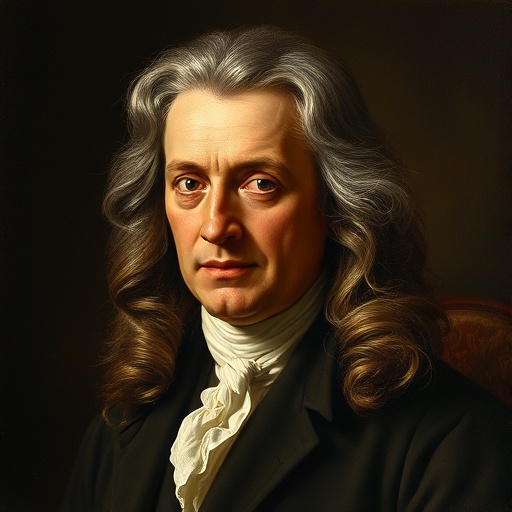
Newton spent his career as a supreme observer - watching light split through prisms, planets trace ellipses, objects fall. He was famously solitary, never married, and viewed the cosmos as a grand design with every element fulfilling its role under natural law. His theological writings described God as the ultimate architect whose creation operated by fixed rules. This detached, observer's perspective - seeing pattern beneath apparent randomness - defined everything Newton did scientifically and personally.
Newton lived through extraordinary upheaval - the English Civil War, regicide, the Restoration of the monarchy, and the Glorious Revolution of 1688. The Scientific Revolution was overturning centuries of religious cosmology. Shakespeare's theater metaphor was culturally familiar; his works were a generation old. As Enlightenment thinkers began systematizing human society alongside nature, seeing life as a governed performance - with discoverable rules rather than divine whim - captured the era's fundamental shift in worldview.
AI-generated insights based on extensive research and information for context. Factual errors? Email [email protected].
Your cart is empty