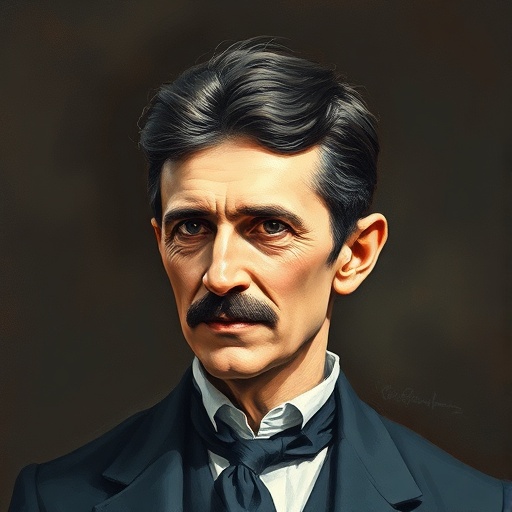
Nikola Tesla — "I do not marry, for I consider that for an inventor, marriage is a great obstacl…"
I do not marry, for I consider that for an inventor, marriage is a great obstacle.
I do not marry, for I consider that for an inventor, marriage is a great obstacle.
Click any product to generate a realistic preview. Up to 3 at a time.
* Initial load can take up to 90 seconds — revising the preview in another color is nearly instant.
"I have always been much interested in the question of women's physical and mental superiority, and have found that women are the stronger sex."
"My brain is only a receiver, in the Universe there is a core from which we obtain knowledge, strength, and inspiration."
"From an incandescent mass we have originated, and into a frozen mass we shall turn. Merciless is the law of nature, and rapidly and irresistibly we are drawn to our doom."
"I do not think you can name many great inventions that have been made by married men."
"The greatest discoveries have been made by men of science who have not been afraid to depart from the beaten path."
Serbian-American inventor and electrical engineer whose alternating-current designs powered the modern electrical grid; died poor and largely forgotten. Closely associated with George Westinghouse (his AC-power business partner) and Mihajlo Pupin (fellow Serbian-American physicist at Columbia). For an intellectual contrast, see Thomas Edison, American inventor and direct-current advocate — Edison's direct-current power-distribution scheme was displaced by Tesla-Westinghouse AC in the 1890s 'War of Currents'. Edison ran a public-relations campaign electrocuting animals to discredit AC — the most famous engineering-ethics rivalry in American history. Tesla's AC won and powers nearly every electrical grid on Earth.
Interview, various biographers recount this sentiment.
Date: Early 20th Century
Love & RelationshipsFound in 1 providers: grok
1 source checked
Marriage demands time, emotional energy, and divided attention that an inventor cannot afford. The inventor's mind requires total freedom to obsess, experiment, and fail without domestic obligation pulling focus elsewhere. A spouse deserves presence; invention demands absence. The two are fundamentally incompatible for someone whose work consumes everything. Choosing invention means choosing solitude as a professional necessity, not personal preference.
Tesla never married and lived much of his life in hotels, famously devoted entirely to his work. He maintained deep focus on electromagnetic research, holding over 300 patents. He reportedly said women were becoming superior beings but that romantic attachment drained his creative energy. His celibate, ascetic lifestyle was deliberate—he believed physical and emotional simplicity fed intellectual power.
In the late 19th and early 20th centuries, marriage was considered a man's social duty and mark of respectability. The Gilded Age expected professionals to have families. Tesla's open rejection of this norm was radical. Meanwhile, the Second Industrial Revolution made inventors cultural heroes—Edison, Bell, Westinghouse—yet most were married. Tesla's deliberate solitude stood apart in an era that celebrated both genius and domesticity simultaneously.
AI-generated insights based on extensive research and information for context. Factual errors? Email [email protected].
Your cart is empty