Richard Feynman — "I don't believe in the idea of a 'genius.' I believe in the idea of a 'hard work…"
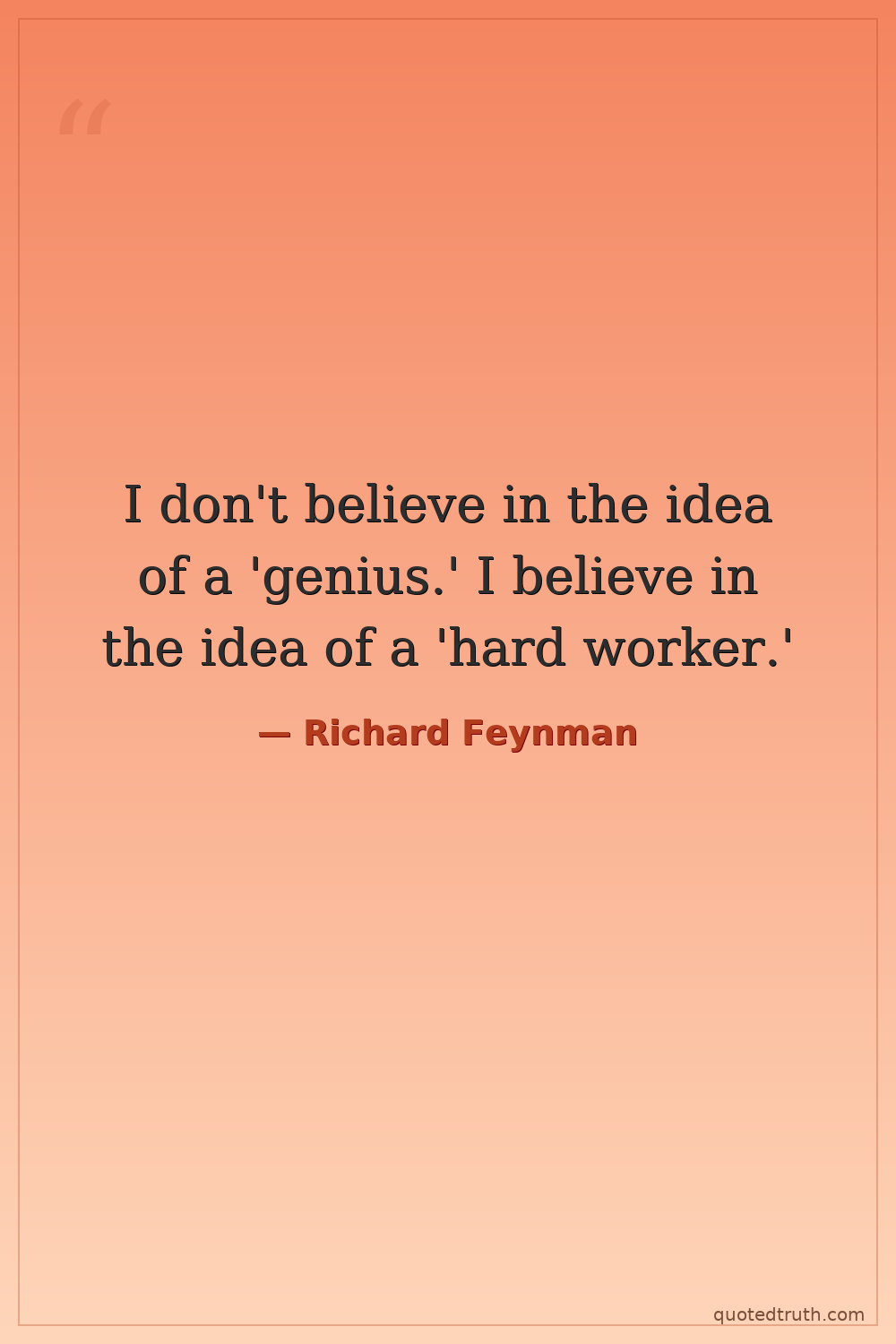
I don't believe in the idea of a 'genius.' I believe in the idea of a 'hard worker.'
I don't believe in the idea of a 'genius.' I believe in the idea of a 'hard worker.'
Click any product to generate a realistic preview. Up to 3 at a time.
* Initial load can take up to 90 seconds — revising the preview in another color is nearly instant.
"Fall in love with some activity, and do it! Nobody ever figures out what life is all about, and it doesn't matter. Explore the world. Nearly everything is really interesting if you go into it deeply e…"
"The age of ignorance is past. The age of reason is here. And it will be a glorious age, if we but choose to make it so."
"The imagination of nature is far, far greater than the imagination of man."
"I'm not a humanitarian. I'm a scientist."
"I don't care what you think. I care what's true."
American theoretical physicist who shared the 1965 Nobel for QED, developed Feynman diagrams, and wrote the Feynman Lectures on Physics. Closely associated with Julian Schwinger (co-Nobelist for QED) and Murray Gell-Mann (Caltech rival and Eightfold-Way physicist). For an intellectual contrast, see Deepak Chopra, physician and quantum-mysticism author — Feynman's Caltech 'cargo cult science' commencement address is the precise template for what he saw as misuse of physics terminology — Chopra-style appropriation of quantum vocabulary for metaphysical claims is the canonical example of what Feynman called 'fooling yourself'.
Found in 1 providers: grok
1 source checked
The quote rejects the idea that exceptional achievement flows from innate, mysterious talent. What gets labeled 'genius' is really the product of sustained effort, deliberate practice, and relentless persistence. Success isn't a supernatural gift reserved for rare individuals—it's earned through choices anyone can make. This democratizes excellence, arguing that disciplined, consistent work is the real engine behind breakthroughs that observers mistake for effortless natural ability.
Despite winning the 1965 Nobel Prize in Physics for quantum electrodynamics, Feynman consistently deflected the 'genius' label. He taught himself calculus at 13, cracked safes recreationally at Los Alamos, and spent decades rebuilding physics from first principles rather than relying on intuition alone. He credited obsessive curiosity and dogged problem-solving for his insights—saying he worked problems until they broke open, not that solutions arrived magically.
Feynman worked through the mid-20th century, when Einstein had become a global symbol of superhuman intellect and the Cold War created urgent demand to identify scientific prodigies. The Space Race and nuclear age mythologized the lone genius. Against that backdrop, Feynman's insistence on effort over innate talent was quietly countercultural—suggesting science's future depended on cultivated rigor, not waiting for the next Einstein to appear by chance.
AI-generated insights based on extensive research and information for context. Factual errors? Email [email protected].
Your cart is empty