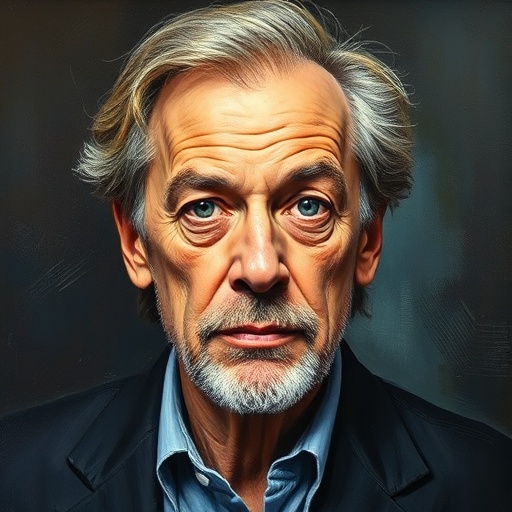
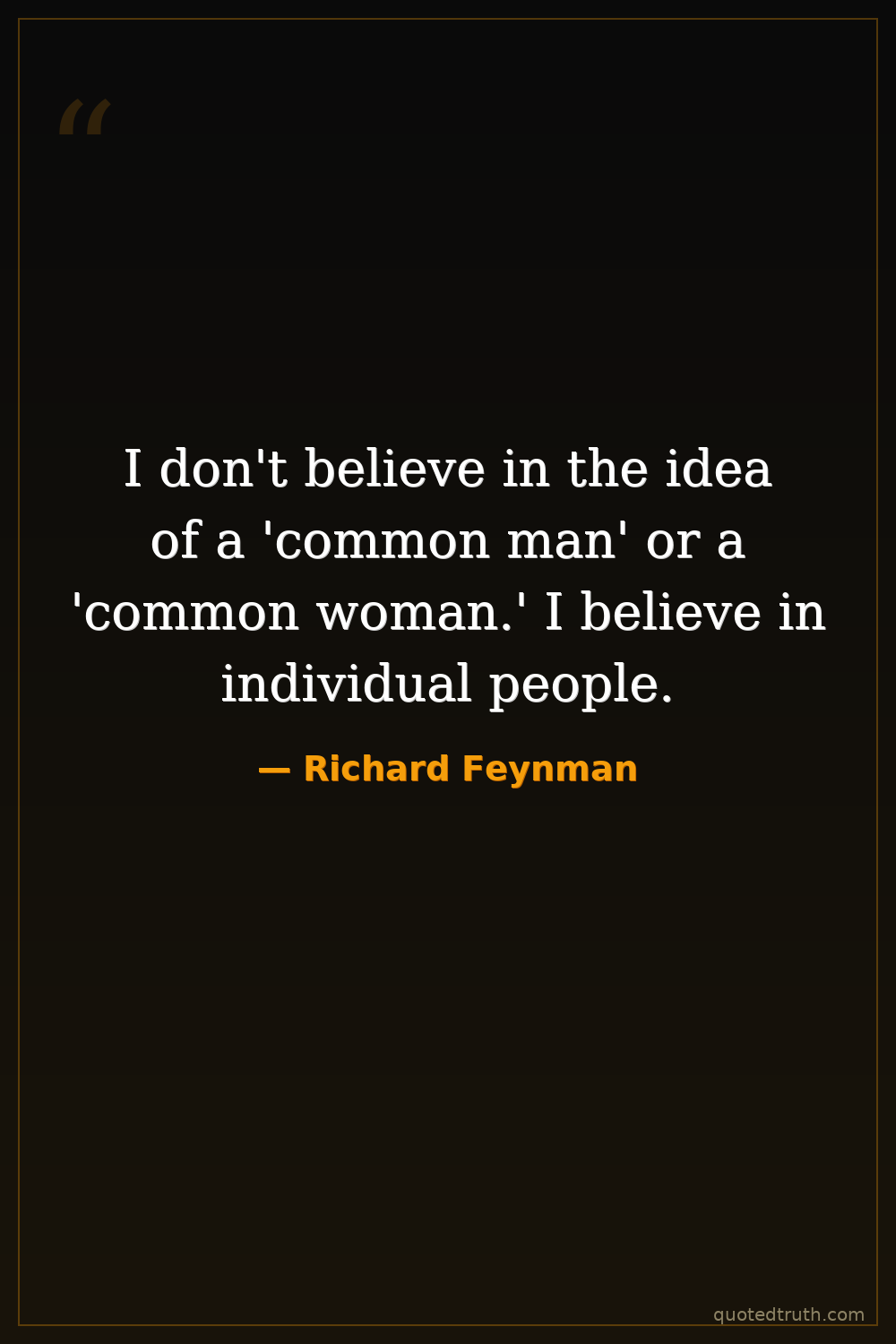
Richard Feynman — "I don't believe in the idea of a 'common man' or a 'common woman.' I believe in …"
I don't believe in the idea of a 'common man' or a 'common woman.' I believe in individual people.
I don't believe in the idea of a 'common man' or a 'common woman.' I believe in individual people.
Click any product to generate a realistic preview. Up to 3 at a time.
* Initial load can take up to 90 seconds — revising the preview in another color is nearly instant.
"The great thing about science is that it's a way of not fooling yourself."
"The game of science is to understand the world."
"It's not enough to be a good scientist. You have to be a good person too."
"I would like to add a third possibility, that it might be that, when we die, we just die, and that's the end of it."
"I was very surprised when I got the Nobel Prize. I didn't think I deserved it."
American theoretical physicist who shared the 1965 Nobel for QED, developed Feynman diagrams, and wrote the Feynman Lectures on Physics. Closely associated with Julian Schwinger (co-Nobelist for QED) and Murray Gell-Mann (Caltech rival and Eightfold-Way physicist). For an intellectual contrast, see Deepak Chopra, physician and quantum-mysticism author — Feynman's Caltech 'cargo cult science' commencement address is the precise template for what he saw as misuse of physics terminology — Chopra-style appropriation of quantum vocabulary for metaphysical claims is the canonical example of what Feynman called 'fooling yourself'.
Found in 1 providers: grok
1 source checked
Feynman rejects the notion that people can be lumped into a generic, averaged category called 'the common person.' He insists every human being is a distinct individual with unique thoughts, experiences, and capabilities. Treating people as a statistical average or demographic bloc misses what actually makes them who they are. Real understanding requires engaging with specific people, not abstractions about humanity.
Feynman was famous for teaching physics to anyone who showed genuine curiosity, from Nobel laureates to dormitory neighbors, treating each as a capable individual. He despised pretension and institutional groupthink, resigned from the National Academy of Sciences, and repeatedly broke from consensus when he believed evidence pointed elsewhere. His entire scientific method centered on the irreducible particularity of how nature actually behaves, not how groups expect it to.
Feynman lived through mid-20th-century America, when mass society rhetoric dominated politics, advertising, and social planning. Cold War ideology on both sides trafficked in collective identities — 'the masses,' 'the American people,' 'the working class.' Postwar social science categorized humans statistically. Feynman's individualism pushed back against this flattening tendency, echoing emerging countercultural skepticism of conformity during the 1950s–1970s.
AI-generated insights based on extensive research and information for context. Factual errors? Email [email protected].
Your cart is empty