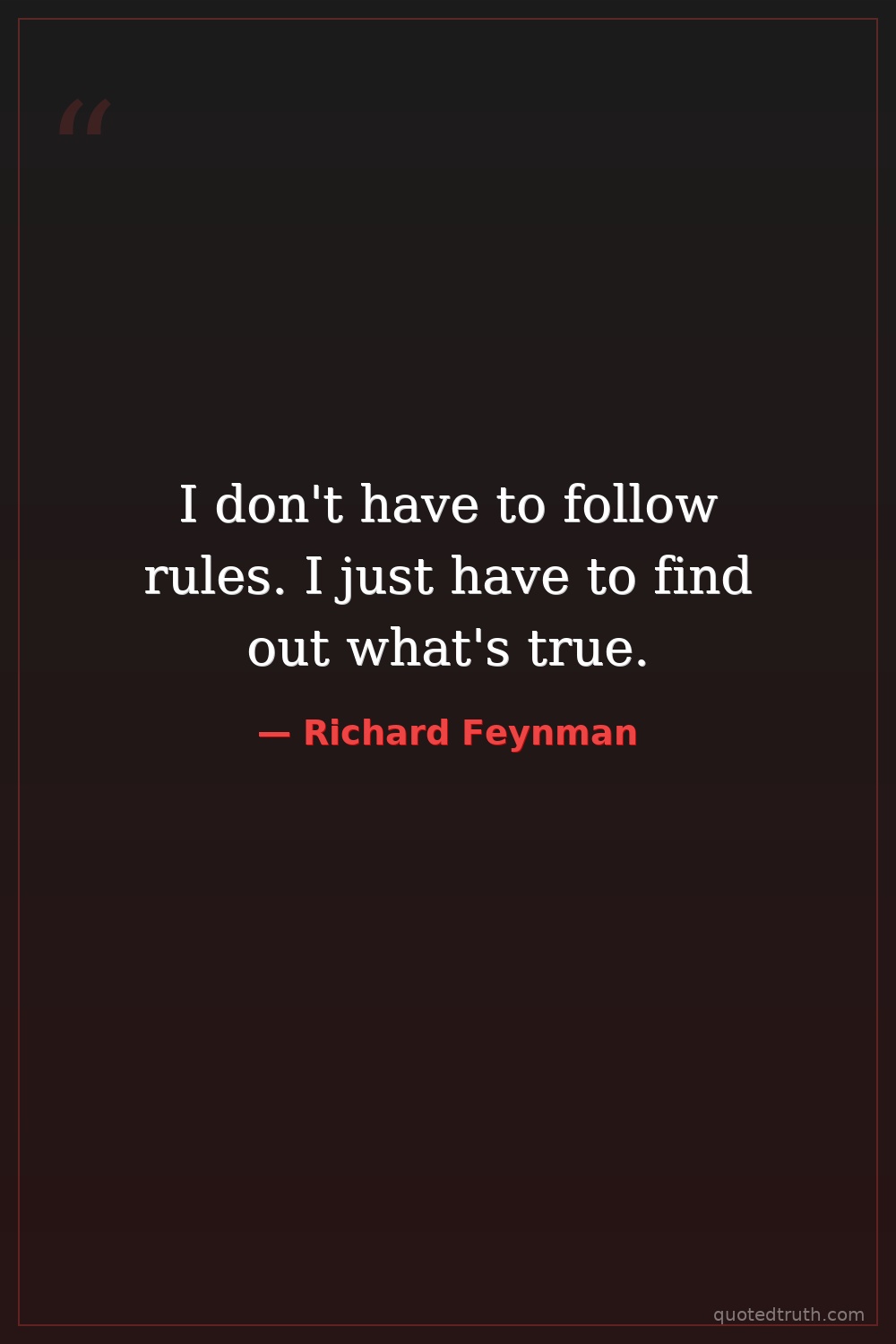
Richard Feynman — "I don't have to follow rules. I just have to find out what's true."
I don't have to follow rules. I just have to find out what's true.
I don't have to follow rules. I just have to find out what's true.
Click any product to generate a realistic preview. Up to 3 at a time.
* Initial load can take up to 90 seconds — revising the preview in another color is nearly instant.
"Why do you suppose that, when you are not speaking English, you speak with an accent?"
"When we know why, we know what to do."
"I was scared because of this same thing I was talking about — I'm not so good at this. “The Dean's tea” — it sounded so silly, you know, and high class."
"I have no respect for age. I have no respect for names. I have no respect for titles. I have respect for understanding."
"I don't understand the world in the way that I think other people claim to understand it."
American theoretical physicist who shared the 1965 Nobel for QED, developed Feynman diagrams, and wrote the Feynman Lectures on Physics. Closely associated with Julian Schwinger (co-Nobelist for QED) and Murray Gell-Mann (Caltech rival and Eightfold-Way physicist). For an intellectual contrast, see Deepak Chopra, physician and quantum-mysticism author — Feynman's Caltech 'cargo cult science' commencement address is the precise template for what he saw as misuse of physics terminology — Chopra-style appropriation of quantum vocabulary for metaphysical claims is the canonical example of what Feynman called 'fooling yourself'.
Found in 1 providers: grok
1 source checked
Truth-seeking requires no permission. Conventional rules, social norms, and institutional expectations are secondary to the actual nature of reality. The universe doesn't care about human hierarchies or approved methods — it only cares about what actually works. Real understanding comes from direct engagement with evidence, not deference to authority or tradition.
Feynman notoriously rejected academic pretension, cracked safes at Los Alamos for fun, and taught himself to pick locks and play bongo drums. He refused honorary titles and despised ceremonial nonsense. His Nobel-winning QED work came from inventing entirely new mathematical notation — Feynman diagrams — rather than following established formalisms. He embodied intellectual independence as a survival strategy.
Post-WWII physics was simultaneously the most rule-bound and rule-breaking field in history. The Manhattan Project showed institutions could mobilize science, but Cold War conformism pressured researchers into orthodoxy. Feynman worked during McCarthyism, Sputnik-era government oversight, and a physics establishment still digesting quantum mechanics — making his iconoclasm both personally risky and scientifically necessary.
AI-generated insights based on extensive research and information for context. Factual errors? Email [email protected].
Your cart is empty