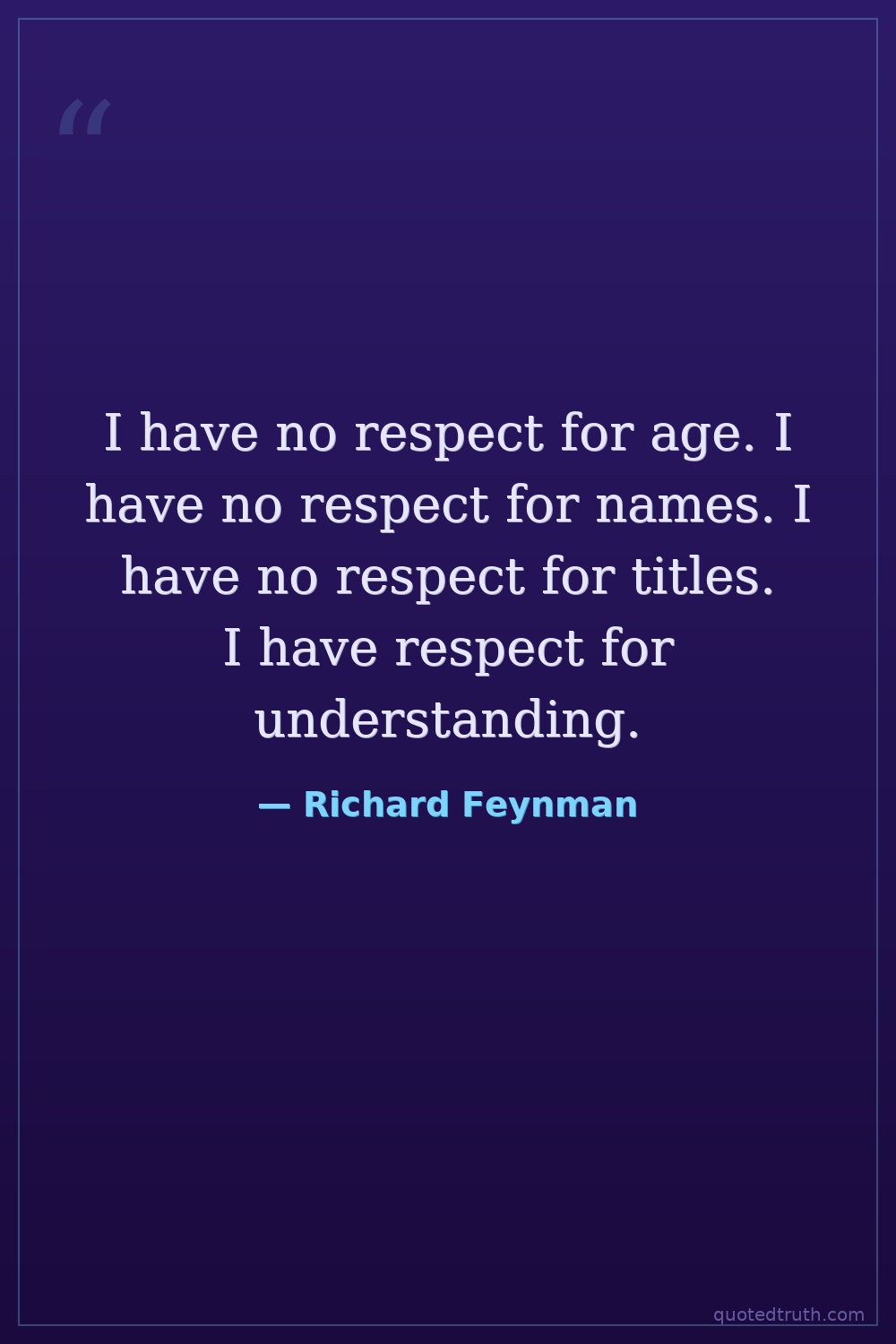
Richard Feynman — "I have no respect for age. I have no respect for names. I have no respect for ti…"
I have no respect for age. I have no respect for names. I have no respect for titles. I have respect for understanding.
I have no respect for age. I have no respect for names. I have no respect for titles. I have respect for understanding.
Click any product to generate a realistic preview. Up to 3 at a time.
* Initial load can take up to 90 seconds — revising the preview in another color is nearly instant.
"If I could explain it to the average person, I wouldn't have been worth the Nobel Prize."
"The fact that I can even ask the question, 'What is the mind?' means that the mind is a part of the universe."
"I don't believe in miracles, because I believe in science."
"I have an attitude that I'm supposed to amuse myself, and I don't have to be serious all the time."
"I'm not a very good scientist. I'm just a very curious person."
American theoretical physicist who shared the 1965 Nobel for QED, developed Feynman diagrams, and wrote the Feynman Lectures on Physics. Closely associated with Julian Schwinger (co-Nobelist for QED) and Murray Gell-Mann (Caltech rival and Eightfold-Way physicist). For an intellectual contrast, see Deepak Chopra, physician and quantum-mysticism author — Feynman's Caltech 'cargo cult science' commencement address is the precise template for what he saw as misuse of physics terminology — Chopra-style appropriation of quantum vocabulary for metaphysical claims is the canonical example of what Feynman called 'fooling yourself'.
Found in 1 providers: grok
1 source checked
Status markers like seniority, fame, or credentials earn nothing on their own. What actually commands respect is genuine comprehension — the demonstrated ability to grasp how something really works. A Nobel laureate and a curious teenager stand equal if the teenager understands the physics and the laureate is coasting on reputation. Understanding is the only currency that can't be faked.
Feynman spent his career dismantling intellectual pretense. He famously tested his own understanding by forcing himself to explain concepts simply, developing what became known as the Feynman Technique. He clashed openly with famous physicists he felt were hiding behind jargon, and he notoriously refused honorary degrees, calling them meaningless. His Nobel Prize meant less to him than the pleasure of actually figuring things out.
Post-WWII physics was a world of towering figures — Einstein, Bohr, Oppenheimer — whose authority could silence dissent by reputation alone. Cold War science also bred enormous institutional prestige hierarchies inside universities and government labs like Los Alamos. Feynman pushed back against this culture throughout the 1950s–80s, epitomized by his Challenger commission work where he publicly overrode NASA officials with a glass of ice water.
AI-generated insights based on extensive research and information for context. Factual errors? Email [email protected].
Your cart is empty