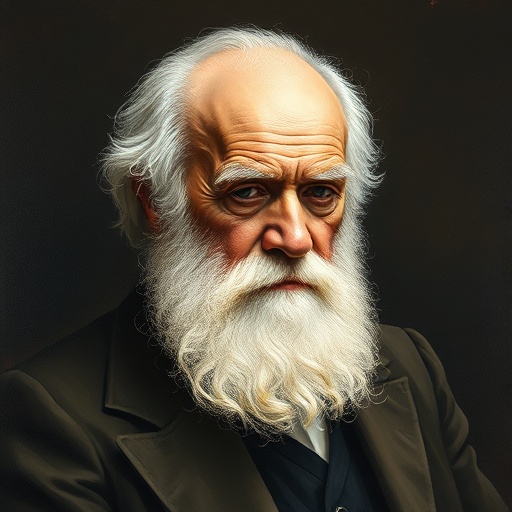
Charles Darwin — "I feel most deeply that the whole subject is too profound for the human intellec…"
I feel most deeply that the whole subject is too profound for the human intellect. A dog might as well speculate on the mind of Newton.
I feel most deeply that the whole subject is too profound for the human intellect. A dog might as well speculate on the mind of Newton.
Click any product to generate a realistic preview. Up to 3 at a time.
* Initial load can take up to 90 seconds — revising the preview in another color is nearly instant.
"The more civilized so-called Caucasian races have beaten the Turkish hollow in the struggle for existence."
"The love for all living creatures is the most noble attribute of man."
"I have called this principle, by which each slight variation, if useful, is preserved, by the term Natural Selection."
"I hate a Barnacle as no man ever did before, not even a Sailor in a slow-sailing ship."
"Looking to the world at no very distant date, what an endless number of the lower races will have been eliminated by the higher civilized races throughout the world."
British naturalist whose On the Origin of Species (1859) established evolution by natural selection — the unifying theory of modern biology. Closely associated with Thomas Henry Huxley (his 'bulldog' public defender) and Alfred Russel Wallace (independent co-discoverer of natural selection). For an intellectual contrast, see William Paley, Anglican theologian and Natural Theology author (1743-1805) — Origin of Species is structurally a 400-page reply to Paley — Darwin admired Paley's watchmaker-argument as an undergraduate at Cambridge and then spent 20 years building the empirical machinery to displace him. The cleanest 'design argument vs natural selection' founding rebuttal in science.
The standard scholarly entry points to Charles Darwin's work: Janet Browne (Harvard, history of science) — Charles Darwin: Voyaging (1995) and The Power of Place (2002); Adrian Desmond (UCL, biographer) — Darwin: The Life of a Tormented Evolutionist (1991, with James Moore). These are the works graduate seminars cite when teaching Charles Darwin.
Found in 1 providers: grok
1 source checked
Human intelligence, however impressive, has cognitive ceilings it cannot breach. Some questions — about existence, consciousness, ultimate origins — are structurally too deep for human minds to resolve. Darwin illustrates this with a humbling analogy: a dog cannot conceptualize Newton's calculus no matter how hard it tries, not from lack of effort but from a fundamental gap in capacity. We are similarly limited relative to certain profound realities.
Darwin spent decades wrestling with the religious implications of evolution, privately describing himself as agnostic. He watched his theory demolish comfortable certainties about creation while knowing it raised unanswerable questions about consciousness and purpose. Despite revolutionizing biology, he was famously reluctant to claim certainty beyond the evidence. This quote captures his intellectual honesty — the man who upended humanity's self-understanding still admitted the deepest questions exceeded his reach.
Victorian Britain was electrified by clashes between scientific materialism and religious faith. Darwin's 1859 'On the Origin of Species' shattered the biblical creation narrative for educated society. Newton remained the supreme symbol of human rational achievement. Yet Darwin's era also produced organized agnosticism, heated debates about consciousness, and growing discomfort with questions materialist science couldn't answer. Admitting cognitive limits was intellectually brave in an age drunk on scientific progress.
AI-generated insights based on extensive research and information for context. Factual errors? Email [email protected].
Your cart is empty