Charles Darwin — "I hate a Barnacle as no man ever did before, not even a Sailor in a slow-sailing…"
I hate a Barnacle as no man ever did before, not even a Sailor in a slow-sailing ship.
I hate a Barnacle as no man ever did before, not even a Sailor in a slow-sailing ship.
Click any product to generate a realistic preview. Up to 3 at a time.
* Initial load can take up to 90 seconds — revising the preview in another color is nearly instant.
"I am turned into a sort of machine for observing facts and grinding out generalizations."
"We are not here concerned with the first origin of life."
"Man tends to increase at a greater rate than his means of subsistence."
"I am a strong believer in the power of observation and the importance of collecting facts."
"I have always felt a strong feeling of gratitude to those who have helped me in my work."
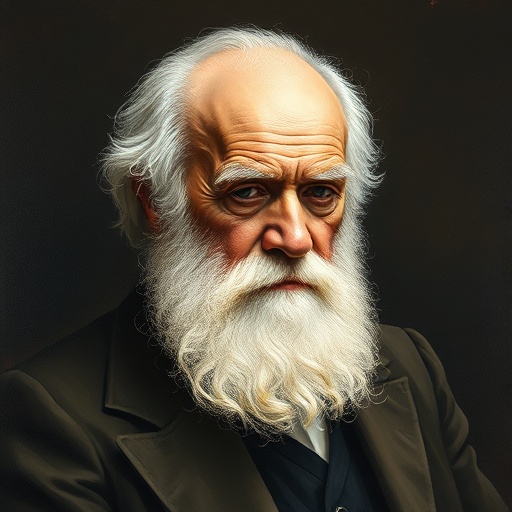
British naturalist whose On the Origin of Species (1859) established evolution by natural selection — the unifying theory of modern biology. Closely associated with Thomas Henry Huxley (his 'bulldog' public defender) and Alfred Russel Wallace (independent co-discoverer of natural selection). For an intellectual contrast, see William Paley, Anglican theologian and Natural Theology author (1743-1805) — Origin of Species is structurally a 400-page reply to Paley — Darwin admired Paley's watchmaker-argument as an undergraduate at Cambridge and then spent 20 years building the empirical machinery to displace him. The cleanest 'design argument vs natural selection' founding rebuttal in science.
The standard scholarly entry points to Charles Darwin's work: Janet Browne (Harvard, history of science) — Charles Darwin: Voyaging (1995) and The Power of Place (2002); Adrian Desmond (UCL, biographer) — Darwin: The Life of a Tormented Evolutionist (1991, with James Moore). These are the works graduate seminars cite when teaching Charles Darwin.
A humorous, yet intense, expression of his frustration during his extensive study of barnacles.
Date: Referring to his work between 1846-1854
WisdomFound in 1 providers: gemini
1 source checked
Darwin is venting comic exhaustion over barnacles — tiny crustaceans he spent eight grueling years studying obsessively. He's saying his loathing surpasses even a sailor's, who hates barnacles for fouling ship hulls and slowing voyages. It's a darkly humorous admission that meticulous scientific work — cataloguing thousands of specimens, dissecting them one by one — can wear down even the most devoted naturalist.
From 1846 to 1854, Darwin devoted eight years to an exhaustive barnacle monograph before publishing On the Origin of Species. The work built his taxonomic credibility among scientists but visibly drained him. He wrote this complaint to a colleague mid-project. His children reportedly assumed all fathers studied barnacles. The grueling dissection of thousands of specimens deepened his understanding of biological variation — foundational to natural selection.
In mid-Victorian Britain, barnacles were a genuine naval nuisance — encrusting ship hulls, slowing Royal Navy vessels, and costing significant money to scrape off. Natural history was simultaneously respectable gentleman's science and imperial duty. Darwin wrote this in the early 1850s, when Britain's maritime supremacy made barnacles culturally familiar, lending his complaint instant relatability — every educated reader understood exactly what fouled-hull hatred felt like.
AI-generated insights based on extensive research and information for context. Factual errors? Email [email protected].
Your cart is empty