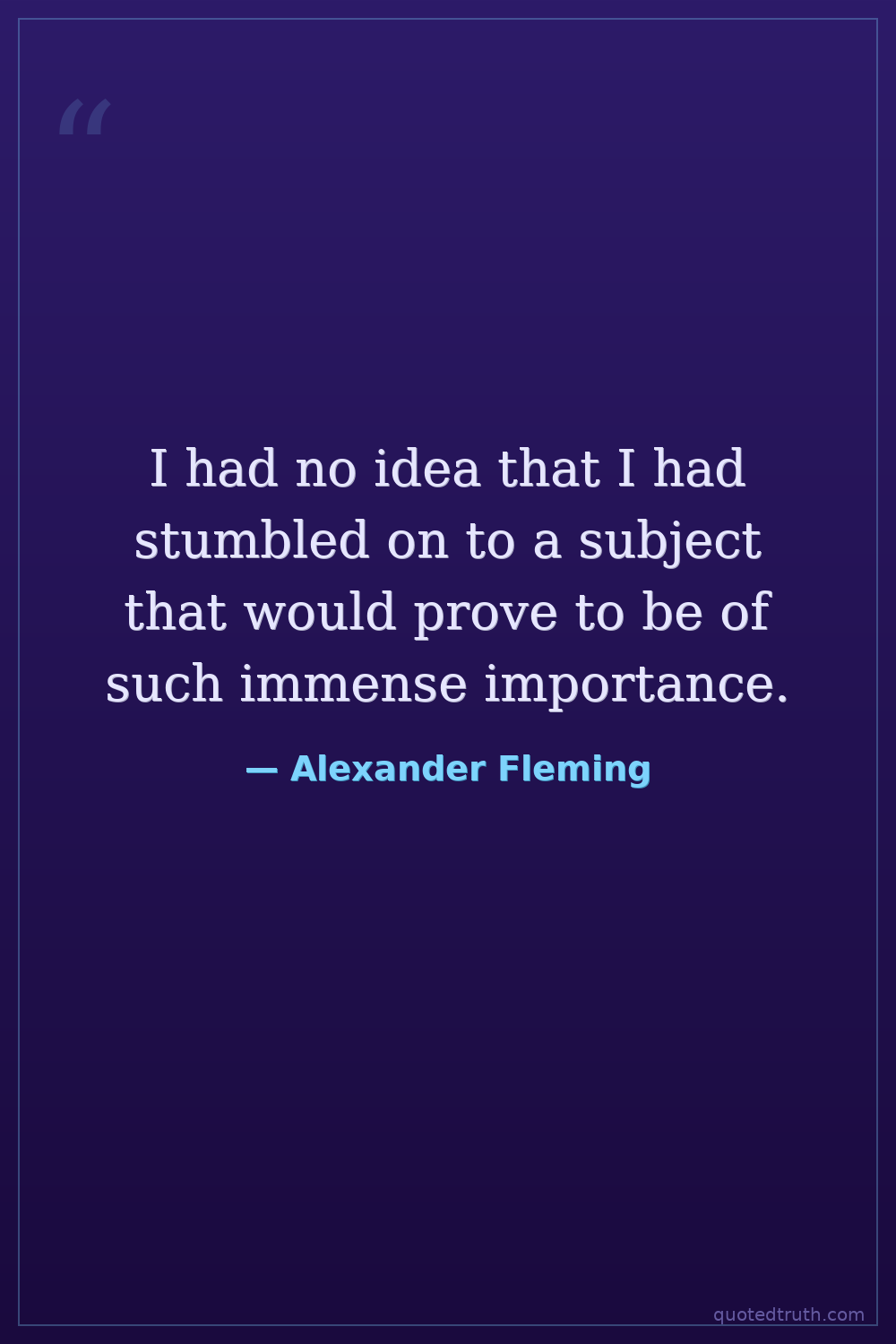
Alexander Fleming — "I had no idea that I had stumbled on to a subject that would prove to be of such…"
I had no idea that I had stumbled on to a subject that would prove to be of such immense importance.
I had no idea that I had stumbled on to a subject that would prove to be of such immense importance.
Click any product to generate a realistic preview. Up to 3 at a time.
* Initial load can take up to 90 seconds — revising the preview in another color is nearly instant.
"I did not invent penicillin. Nature did. I just found it."
"I found penicillin and have given it free for the benefit of humanity. Why should it become a profit-making monopoly of manufacturers in another country?"
"The discovery of penicillin was a series of lucky accidents."
"It is not enough to discover a thing; one must also know how to use it."
"I am not an orator, but a simple bacteriologist."
Found in 1 providers: grok
1 source checked
Fleming admits that when he first noticed something unusual, he had no clue it would become world-changing. He is acknowledging that a major breakthrough began as a small, almost trivial observation, and that he could not foresee the scale of its impact. In plain terms, he is saying great discoveries often start by accident, and the person who finds them rarely realizes what they have until much later.
Fleming literally stumbled onto penicillin in 1928 when he noticed a stray Penicillium mold killing bacteria on a contaminated petri dish in his cluttered London lab. A modest, understated Scottish bacteriologist, he initially published the finding to little fanfare and moved on. Only after Florey and Chain industrialized it in the 1940s did its life-saving scale become clear. The quote captures his trademark humility about a discovery that ultimately earned him a Nobel Prize and reshaped medicine.
Fleming worked in the interwar period, when bacterial infections like pneumonia, sepsis, and wound infections routinely killed people, and physicians had almost no effective treatments. World War I had exposed the brutal limits of antiseptics on infected wounds, motivating his research. By the time penicillin was mass-produced during World War II, it was saving Allied soldiers from gangrene and syphilis on an unprecedented scale, launching the antibiotic era and fundamentally transforming twentieth-century medicine and life expectancy.
AI-generated insights based on extensive research and information for context. Factual errors? Email [email protected].
Your cart is empty