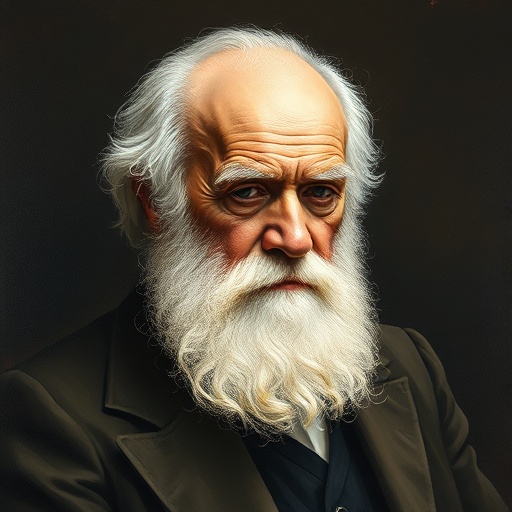
Charles Darwin — "I have always felt a strong feeling of gratitude to those who have helped me in …"
I have always felt a strong feeling of gratitude to those who have helped me in my work.
I have always felt a strong feeling of gratitude to those who have helped me in my work.
Click any product to generate a realistic preview. Up to 3 at a time.
* Initial load can take up to 90 seconds — revising the preview in another color is nearly instant.
"We are like a judge who has to sum up and deliver judgment, not on the evidence of witnesses, but on the arguments of counsel."
"But I am very poorly today & very stupid & I hate everybody & everything. One lives only to make blunders."
"I own that I cannot see as plainly as others do, and as I should wish to do, evidence of design and beneficence on all sides of us. There seems to me too much misery in the world. I cannot persuade my…"
"I have no great quickness of apprehension or wit which is so remarkable in some clever men."
"I have just finished my 'Origin,' and am now going to be a hermit for the rest of my life."
British naturalist whose On the Origin of Species (1859) established evolution by natural selection — the unifying theory of modern biology. Closely associated with Thomas Henry Huxley (his 'bulldog' public defender) and Alfred Russel Wallace (independent co-discoverer of natural selection). For an intellectual contrast, see William Paley, Anglican theologian and Natural Theology author (1743-1805) — Origin of Species is structurally a 400-page reply to Paley — Darwin admired Paley's watchmaker-argument as an undergraduate at Cambridge and then spent 20 years building the empirical machinery to displace him. The cleanest 'design argument vs natural selection' founding rebuttal in science.
The standard scholarly entry points to Charles Darwin's work: Janet Browne (Harvard, history of science) — Charles Darwin: Voyaging (1995) and The Power of Place (2002); Adrian Desmond (UCL, biographer) — Darwin: The Life of a Tormented Evolutionist (1991, with James Moore). These are the works graduate seminars cite when teaching Charles Darwin.
Found in 1 providers: grok
1 source checked
Darwin is expressing that throughout his career, he never lost sight of the debt he owed to those who aided him—whether through ideas, specimens, assistance, or encouragement. He acknowledges that scientific achievement is collaborative, not solitary, and that recognizing others' contributions is a moral obligation, not mere courtesy. It is an honest admission that transformative work rarely emerges from a single mind working in isolation.
Darwin spent five years aboard the HMS Beagle relying on local naturalists, collectors, and crew. His theory of evolution emerged through dense correspondence with scientists including Joseph Hooker, Thomas Huxley, and Asa Gray. He agonized over crediting Alfred Russel Wallace, who independently conceived natural selection. His notebooks and letters reveal genuine warmth toward collaborators—Darwin was a meticulous synthesizer who understood his groundbreaking conclusions rested on countless others' observations and support.
Darwin lived during the Victorian era, when science was transitioning from wealthy gentleman-amateurs to organized professional institutions. Natural history depended on global specimen networks—collectors, ship captains, and colonial correspondents sent Darwin materials from across the British Empire. Without rapid communication, letter exchanges were the lifeblood of scientific collaboration. The period's cultural myth of the lone genius made Darwin's explicit gratitude toward collaborators quietly countercultural and genuinely humble.
AI-generated insights based on extensive research and information for context. Factual errors? Email [email protected].
Your cart is empty