What it means
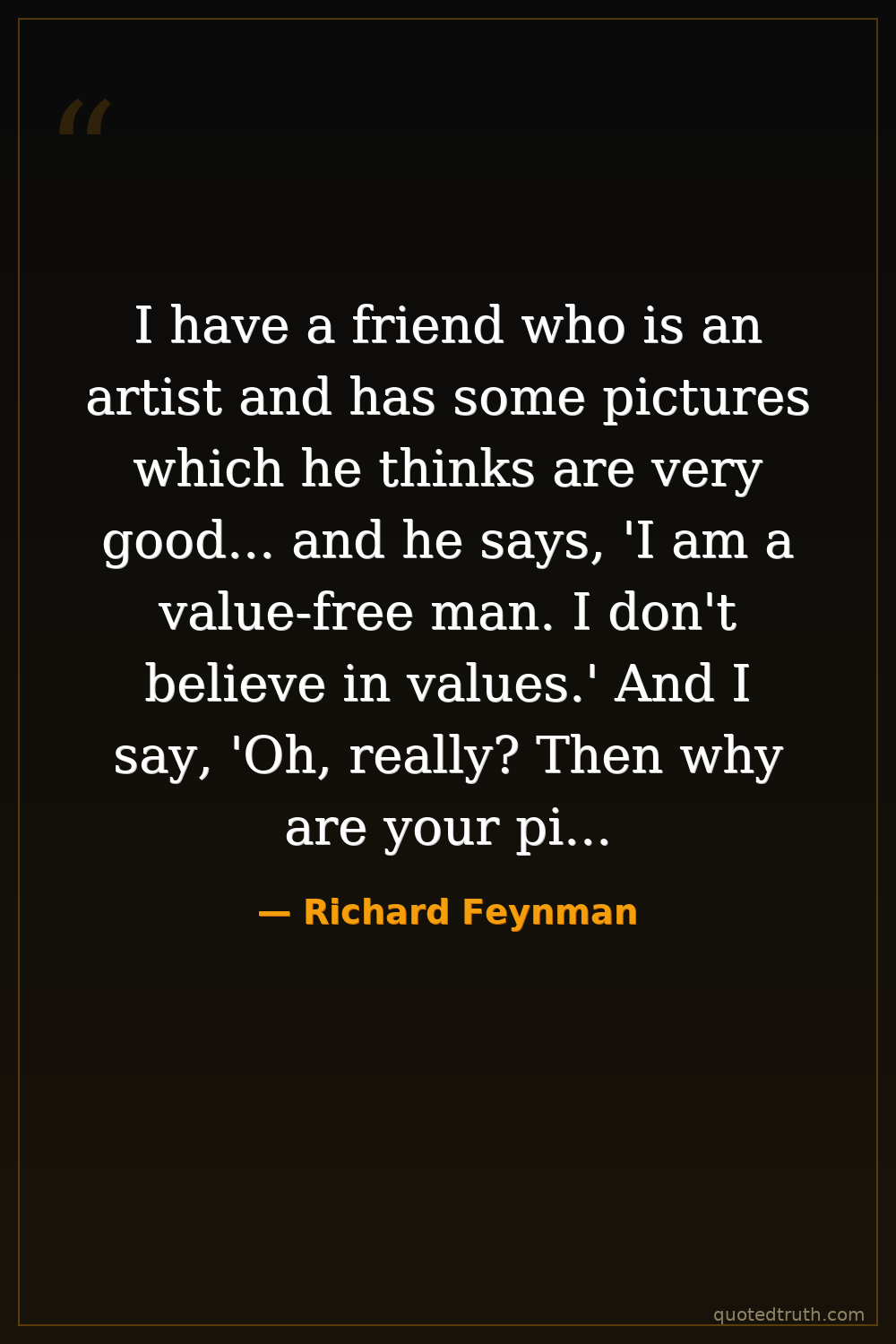
Feynman exposes a contradiction in claiming to be 'value-free': the moment someone calls their own work 'good,' they've invoked a value judgment. You cannot simultaneously deny that values exist and assert quality. The position collapses under its own weight. Rejecting values in principle while making aesthetic claims in practice is incoherent — values are inescapable the moment you prefer anything over anything else.
Relevance to Richard Feynman
Feynman prized intellectual honesty above all else and had zero tolerance for self-deception. As a physicist who built rigorous frameworks for evaluating truth, he instinctively spotted logical contradictions in everyday reasoning. He was also deeply engaged with art — he painted, played bongo drums, and frequented strip clubs to sketch — so aesthetic value judgments were personal terrain, not abstract philosophy.
The era
Post-WWII Western culture saw a rise in relativism and value-neutral posturing, partly as a reaction against ideological dogma that fueled fascism and Stalinism. By the 1960s–70s, 'I don't believe in values' had become a fashionable intellectual pose in artistic and academic circles. Feynman's era was also the height of scientific triumphalism, when rigorous logical consistency was newly prized as the gold standard for any serious claim.
AI-generated insights based on extensive research and information for context. Factual errors? Email [email protected].