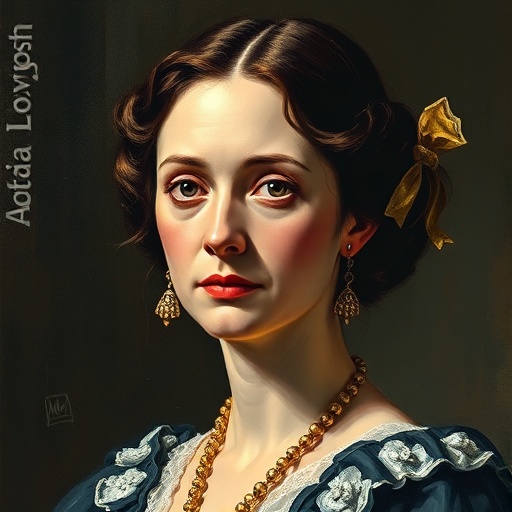
Ada Lovelace — "I have a most unladylike thirst for knowledge."
I have a most unladylike thirst for knowledge.
I have a most unladylike thirst for knowledge.
Click any product to generate a realistic preview. Up to 3 at a time.
* Initial load can take up to 90 seconds — revising the preview in another color is nearly instant.
"The Analytical Engine provides us with new means of operating on general symbols, and consequently of generalizing our ideas."
"I believe myself to be a rare combination of the imaginative faculty and the mathematical faculty, which is rare, and therefore valuable."
"I am a firm believer in the power of self-education."
"The Analytical Engine is capable of carrying out operations of any complexity, provided that they can be expressed in a symbolic form."
"I have a peculiar turn of mind, which I believe is useful for scientific pursuits."
Found in 1 providers: grok
1 source checked
An admission that her hunger for learning was fierce, relentless, and socially transgressive. She's acknowledging — almost defiantly — that women were expected to be decorative and docile, not intellectually voracious. By calling it 'unladylike,' she reclaims the insult: her drive to understand mathematics, science, and ideas wasn't a flaw to suppress but an identity to own. She wanted to know everything, and she refused to apologize for it.
Lovelace was tutored in mathematics partly to suppress her poet-father Byron's 'dangerous' romantic temperament — yet she devoured it far beyond anyone's expectations. She corresponded with the era's top scientists, translated and massively expanded Menabrea's paper on Babbage's Analytical Engine, adding algorithms entirely her own. Her notes envisioned computing as more than arithmetic. That ferocious, self-directed intellectual hunger drove her to become the first person to write what we now call a computer program.
Victorian England defined femininity through submission and domesticity — women were barred from universities, scientific societies, and most intellectual professions. Curiosity in women was tolerated only as a drawing-room ornament, never a serious pursuit. Meanwhile, the Industrial Revolution was birthing entirely new sciences: thermodynamics, statistics, mechanical computation. Lovelace sat at the exact intersection of a world exploding with new knowledge and a culture that told women they had no right to touch it.
AI-generated insights based on extensive research and information for context. Factual errors? Email [email protected].
Your cart is empty