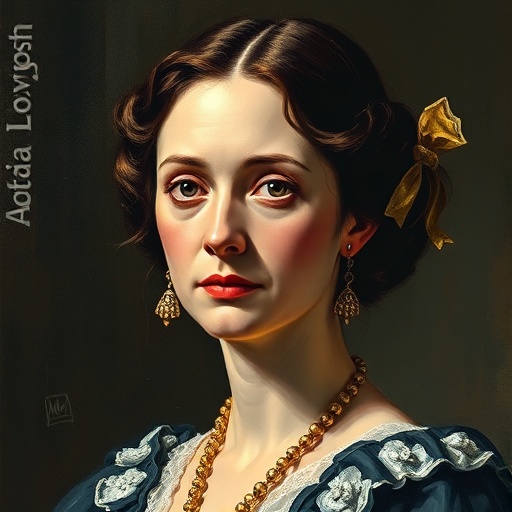
Ada Lovelace — "I believe myself to be a rare combination of the imaginative faculty and the mat…"
I believe myself to be a rare combination of the imaginative faculty and the mathematical faculty, which is rare, and therefore valuable.
I believe myself to be a rare combination of the imaginative faculty and the mathematical faculty, which is rare, and therefore valuable.
Click any product to generate a realistic preview. Up to 3 at a time.
* Initial load can take up to 90 seconds — revising the preview in another color is nearly instant.
"I am most anxious to get the work done well, and to make it a first-rate thing."
"I am a woman of science, and I am proud of it."
"The Analytical Engine is not merely a calculating machine. It is a thinking machine."
"The Analytical Engine might act upon other things besides number, were objects found whose mutual fundamental relations could be expressed by those of the abstract science of operations, and which sho…"
"I am convinced that the future of knowledge lies in the development of machines that can assist the human mind."
Found in 1 providers: grok
1 source checked
The quote asserts that possessing both creative imagination and rigorous mathematical ability within one mind is exceptionally rare. Rather than false modesty, it is a lucid self-assessment: most people excel at one or the other. She argues this dual aptitude has genuine practical worth — that where art meets logic, uniquely powerful thinking emerges. In modern terms, she is describing the rarest kind of innovator: someone who can both envision boldly and execute with precision.
Lovelace was the daughter of Romantic poet Lord Byron, yet her mother, fearing she would inherit his instability, raised her under strict mathematical discipline. She fused both inheritances: her notes on Babbage's Analytical Engine went far beyond calculation, imagining it composing music and manipulating symbols. She called herself an 'Analyst and Metaphysician.' This quote is essentially her personal manifesto — the conviction that drove the world's first published algorithm into existence.
Victorian England in the 1840s was torn between Romanticism, which glorified poetic imagination, and industrialization demanding cold rational logic. Mathematics was considered a masculine domain; women who pursued it faced dismissal or condescension. Babbage's Analytical Engine had no established field around it — programming did not yet exist as a concept. Lovelace's self-description challenged both norms at once: she claimed mathematical authority as a woman while insisting imagination belonged inside the emerging machine age.
AI-generated insights based on extensive research and information for context. Factual errors? Email [email protected].
Your cart is empty