Richard Feynman — "I have a theory that the universe is a great big safe, and that there's a combin…"
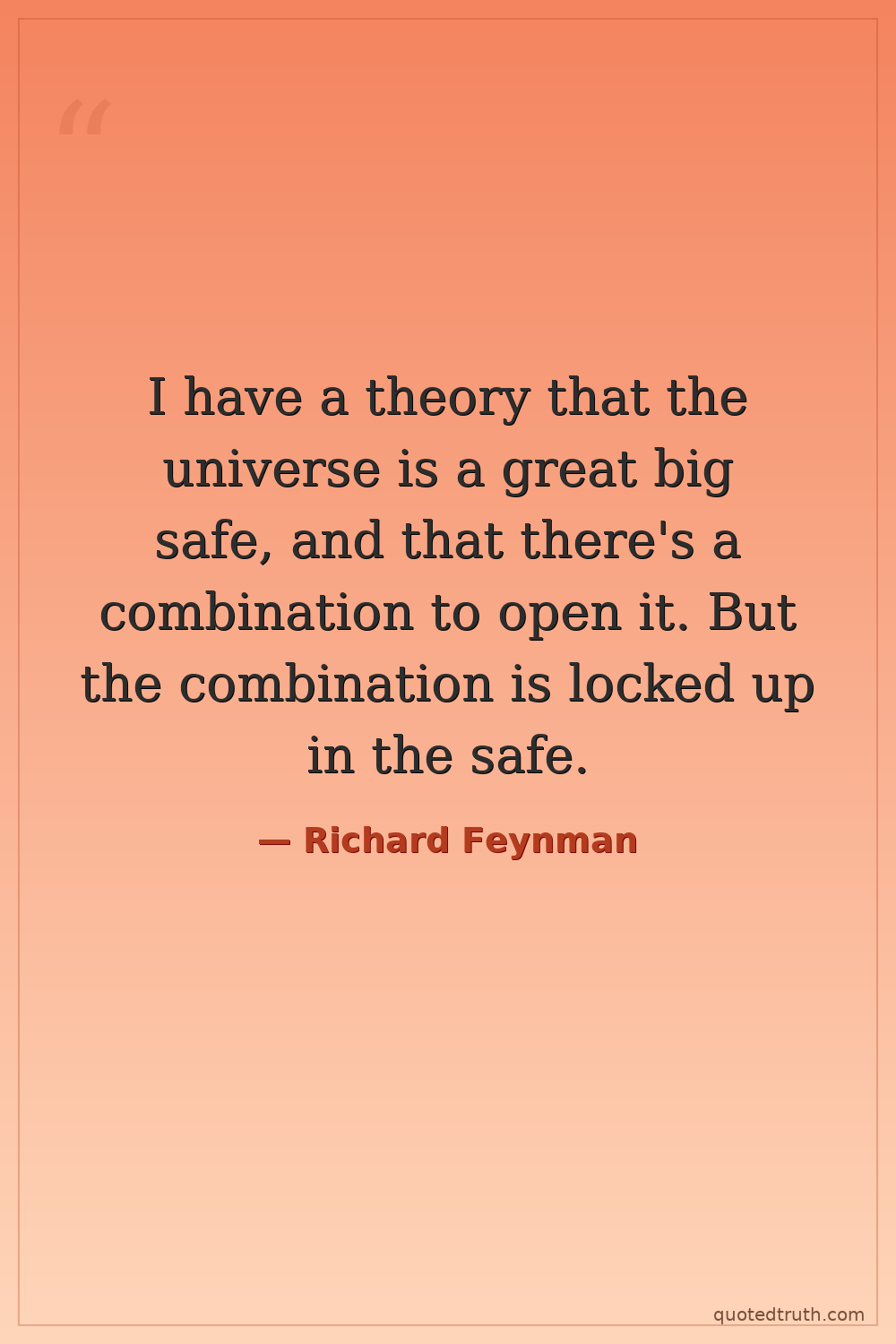
I have a theory that the universe is a great big safe, and that there's a combination to open it. But the combination is locked up in the safe.
I have a theory that the universe is a great big safe, and that there's a combination to open it. But the combination is locked up in the safe.
Click any product to generate a realistic preview. Up to 3 at a time.
* Initial load can take up to 90 seconds — revising the preview in another color is nearly instant.
"I took the wavicles—the little particles of waves—and put them in a box."
"I'd hate to die twice. It's so boring."
"The game is to find out how nature works."
"The thing about science is that it's all about discovery. It's all about trying to find out what's going on."
"I have a friend who's an artist and has sometimes taken a view which I don't agree with. He'll hold up a flower and say, 'Look how beautiful it is,' and I'll agree. Then he says, 'You see, as a scient…"
American theoretical physicist who shared the 1965 Nobel for QED, developed Feynman diagrams, and wrote the Feynman Lectures on Physics. Closely associated with Julian Schwinger (co-Nobelist for QED) and Murray Gell-Mann (Caltech rival and Eightfold-Way physicist). For an intellectual contrast, see Deepak Chopra, physician and quantum-mysticism author — Feynman's Caltech 'cargo cult science' commencement address is the precise template for what he saw as misuse of physics terminology — Chopra-style appropriation of quantum vocabulary for metaphysical claims is the canonical example of what Feynman called 'fooling yourself'.
Found in 1 providers: grok
1 source checked
Reality operates by rules that can theoretically be discovered, but the tools needed to uncover those rules are themselves hidden within reality. It captures a fundamental epistemological trap: to fully understand the universe, you need knowledge that can only come from understanding the universe. Progress is real but complete knowledge remains perpetually just out of reach, teasing us forward.
Feynman spent his career probing quantum electrodynamics, the rules governing how light and matter interact at the deepest level. He won the Nobel Prize for cracking one layer of the combination, yet publicly celebrated uncertainty and admitted ignorance. His Caltech lectures and "The Character of Physical Law" repeatedly argued that nature is stranger than our intuitions allow, making this self-referential puzzle deeply personal.
Feynman worked during the Cold War nuclear and space age, when physics held near-mythical cultural status. Scientists had split the atom and launched satellites, suggesting the universe's secrets were yielding fast. Yet quantum mechanics simultaneously revealed that observation itself alters reality. This tension between triumphant discovery and deepening mystery made Feynman's paradox resonate powerfully across mid-to-late twentieth century scientific culture.
AI-generated insights based on extensive research and information for context. Factual errors? Email [email protected].
Your cart is empty