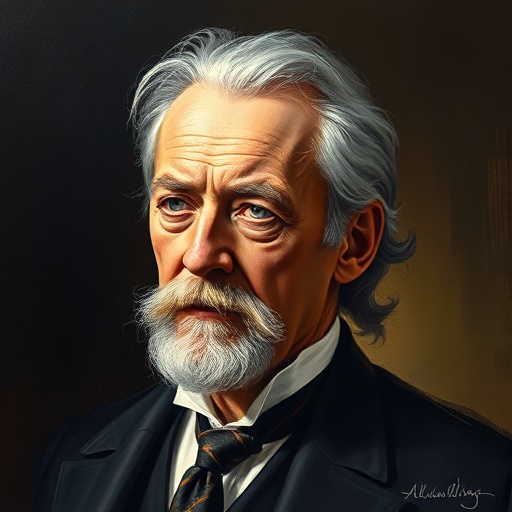
Alexander Fleming — "I have always been interested in the fight against disease."
I have always been interested in the fight against disease.
I have always been interested in the fight against disease.
Click any product to generate a realistic preview. Up to 3 at a time.
* Initial load can take up to 90 seconds — revising the preview in another color is nearly instant.
"It is a matter of great satisfaction to see penicillin saving so many lives."
"I have always been interested in the effect of one microbe on another."
"I can only warn. It is up to others to heed the warning."
"I am very grateful for the recognition I have received, but the real credit belongs to the mould."
"The discovery of penicillin was a series of lucky accidents."
Found in 1 providers: grok
1 source checked
Lifelong dedication to a single purpose: fighting illness. Fleming isn't claiming credit or boasting — he's explaining his core motivation. Throughout his entire life, from medical training to laboratory research, the battle against disease was what drew his attention and energy. This captures the mindset of someone who sees science not as a career but as a mission — one that naturally led him toward discovering treatments that save lives.
Fleming served as a military doctor in WWI, watching soldiers die from infected wounds — not bullets — which crystallized his obsession with infection. At St. Mary's Hospital in London, he discovered lysozyme in 1922 and penicillin in 1928, both from bacterial phenomena he refused to dismiss. His Nobel Prize in 1945 confirmed what he always believed: that curiosity directed toward disease, not prestige, defined his entire scientific identity.
Fleming worked during an era when bacterial infections — pneumonia, sepsis, tuberculosis — were among humanity's top killers, with no reliable treatments. WWI demonstrated devastatingly that infected wounds killed more soldiers than enemy fire. The 1918 influenza pandemic killed 50 million people worldwide. Medicine had germ theory but few weapons against it. Penicillin's mass production in WWII finally turned the tide, making Fleming's lifelong fight historically transformative rather than merely aspirational.
AI-generated insights based on extensive research and information for context. Factual errors? Email [email protected].
Your cart is empty