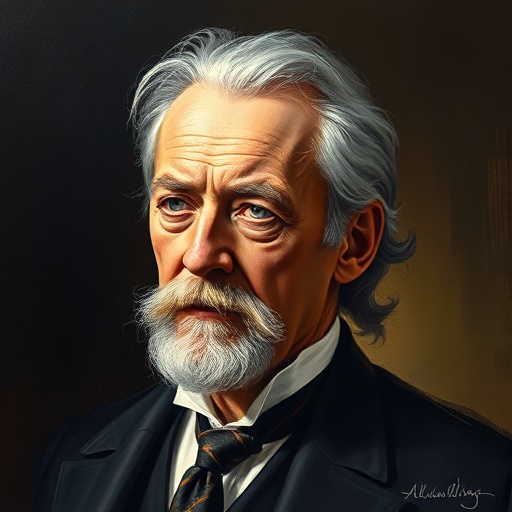
Alexander Fleming — "I have been accused of being untidy. I confess to being untidy, but I have never…"
I have been accused of being untidy. I confess to being untidy, but I have never allowed my untidiness to interfere with my work.
I have been accused of being untidy. I confess to being untidy, but I have never allowed my untidiness to interfere with my work.
Click any product to generate a realistic preview. Up to 3 at a time.
* Initial load can take up to 90 seconds — revising the preview in another color is nearly instant.
"When I woke up just after dawn on September 28, 1928, I certainly didn't plan to revolutionize all medicine by discovering the world's first antibiotic, or bacteria killer. But I suppose that was exac…"
"I am very grateful for the recognition I have received, but the real credit belongs to the mould."
"The thought that I might have discovered something which would be of value in treating disease was, of course, uppermost in my mind."
"My greatest satisfaction comes from knowing that my work has saved countless lives."
"It is not an exaggeration to say that the discovery of penicillin has saved millions of lives."
Found in 1 providers: grok
1 source checked
Fleming admits he is messy and disorganized, but insists his clutter never compromises the quality or rigor of his work. He is pushing back against critics who equate a tidy desk with a disciplined mind, arguing that personal habits and professional results are separate measures. What matters is the output, not the appearance of the workspace, and judging someone by neatness alone misses the substance of what they actually accomplish.
Fleming's famous 1928 discovery of penicillin happened precisely because of his untidiness: he left a stack of staphylococcus plates uncovered while on vacation, and returned to find a Penicillium mold had killed the bacteria around it. A tidier scientist would have washed the plates and missed the contamination entirely. His Nobel-winning breakthrough literally depended on the cluttered, casual lab habits that colleagues criticized, vindicating his defense.
Fleming worked at St. Mary's Hospital, London, through the early-to-mid 20th century, an era when bacterial infections like pneumonia, sepsis, and wound infection routinely killed people and World War I had exposed the desperate need for antibacterial agents. Laboratory science was professionalizing, with strict expectations of methodical technique. His 1928 observation, developed by Florey and Chain in the 1940s, launched the antibiotic era and saved millions of Allied soldiers in WWII.
AI-generated insights based on extensive research and information for context. Factual errors? Email [email protected].
Your cart is empty