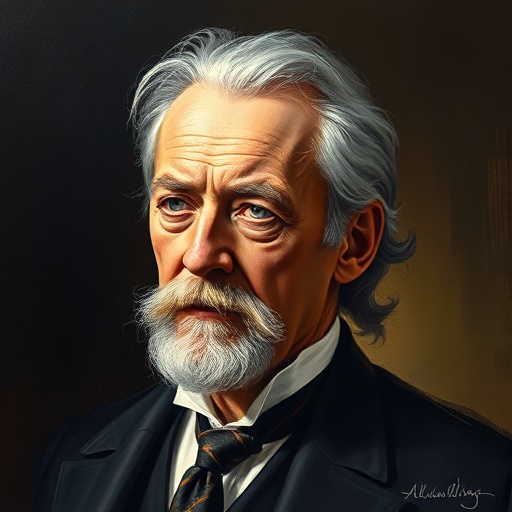
Alexander Fleming — "My greatest satisfaction comes from knowing that my work has saved countless liv…"
My greatest satisfaction comes from knowing that my work has saved countless lives.
My greatest satisfaction comes from knowing that my work has saved countless lives.
Click any product to generate a realistic preview. Up to 3 at a time.
* Initial load can take up to 90 seconds — revising the preview in another color is nearly instant.
"I found penicillin and have given it free for the benefit of humanity. Why should it become a profit-making monopoly of manufacturers in another country?"
"The accidental contamination of my cultures by a mold was not an unusual event in a bacteriological laboratory. What was unusual was my decision to investigate the mold."
"I play with microbes. There are, of course, many rules to this play...but when you have acquired knowledge and experience it is very pleasant to break the rules and to be able to find something nobody…"
"The impact of penicillin on modern medicine is immeasurable."
"Many difficulties were encountered in the early attempts to isolate and purify penicillin."
Found in 1 providers: grok
1 source checked
Personal fulfillment isn't found in recognition or money, but in knowing your efforts tangibly improved the world. The deepest reward for a life's work is its real impact on human survival — not awards, not credit, not legacy for its own sake. Satisfaction comes from contribution, specifically from knowing that real people are alive today because of what you discovered and dedicated yourself to.
Fleming discovered penicillin in 1928 when a mold contaminated a lab culture and killed surrounding bacteria. Rather than discarding the plate, he investigated. For years his findings were overlooked; Florey and Chain later developed it into a deployable antibiotic. During WWII, penicillin saved hundreds of thousands of wounded soldiers. Fleming won the Nobel Prize in 1945 and consistently deflected personal glory, focusing instead on medicine's duty to humanity.
In the early 20th century, bacterial infections were death sentences — pneumonia, sepsis, and infected wounds killed millions annually. WWI revealed how infections killed more soldiers than combat. No targeted treatments existed; surgery was routinely fatal from post-operative infection. By WWII, penicillin had entered mass production, slashing battlefield mortality dramatically. The era marked medicine's pivot from helplessness against infection to genuine cure, making antibiotics the defining medical achievement of the century.
AI-generated insights based on extensive research and information for context. Factual errors? Email [email protected].
Your cart is empty